


Aquasonic Entire Range
-

Aquasonic Aquasonic - pH Up (500g)
Aquasonic pH-Up is for reducing acidity. Made from high grade chemicals and works instantly. Treatment: Used to quickly raise pH Result: Will raise pH. Varies according to initial pH. Dose Rate: 1 teaspoon per 70 litres in a 12hr period. Use until desired pH is reached.
$14.79
-

Aquasonic Aquasonic - Carbonate Hardness Generator (500g)
The Carbonate Hardness (kH) or also referred to as alkalinity of water is the basis for pH values. The stability of pH can be ensured by raising carbonate hardness levels without effect on general hardness.Acids produced in closed circuit aquaria continuously reduce the carbonate hardness levels. Carbonate Hardness Generator is a special blend of pH buffers that provide a sustained kH level for longer than if using just sodium bicarbonate. Prior raising of carbonate levels will avert drastic falls in pH resultant from these acids, acting to maintain a more stable pH. Directions for Use: 4g (approx. 1 teaspoon) per 100L of water or 40g per 1000L of water raises carbonate hardness levels by 20ppm. Caution pH levels may rise. It is not recommended to raise carbonate hardness values by more than 20ppm per day.To calculate approximate aquarium capacity: Multiply the length x width x height (in cm) and divide by 1,000 for litres.
$17.59
-

Aquasonic Aquasonic - Carbonate Hardness Generator (100g)
The Carbonate Hardness (kH) or also referred to as alkalinity of water is the basis for pH values. The stability of pH can be ensured by raising carbonate hardness levels without effect on general hardness.Acids produced in closed circuit aquaria continuously reduce the carbonate hardness levels. Carbonate Hardness Generator is a special blend of pH buffers that provide a sustained kH level for longer than if using just sodium bicarbonate. Prior raising of carbonate levels will avert drastic falls in pH resultant from these acids, acting to maintain a more stable pH. Directions for Use: 4g (approx. 1 teaspoon) per 100L of water or 40g per 1000L of water raises carbonate hardness levels by 20ppm. Caution pH levels may rise. It is not recommended to raise carbonate hardness values by more than 20ppm per day.To calculate approximate aquarium capacity: Multiply the length x width x height (in cm) and divide by 1,000 for litres.
$13.39
-

Aquasonic Aquasonic - Bio-Tet (100 tablets)
Aquasonic Bio-Tet tablets are a broad spectrum antibiotic that treats disease in ornamental fresh & salt water aquarium fish caused by tetracycline sensitive bacteria. Directions for Use: Do not swallow. Do not use on fish intended for human consumption. Remove activated carbon or other absorbent materials from filtration system and slow flow rate of sub-gravel filtration for the duration of the treatment.Use of an isolated treatment tank as a hospital tank for affected fish is recommended and ensure the water is as similar as possible to the main aquarium (pH, temperature, salinity, etc.) Aerate vigorously during treatment. Dosage Rate: Use 1 tablet per 20 litres of aquarium water. If conditions do not improve, consult your veterinarian or aquarium dealer. Replace aquarium water after successful treatment. To calculate approximate tank capacity multiply length x width x water level height (in cm) and divide by 1,000 for litres. CAUTION. Keep out of reach of children. For animal treatment only. First Aid Instructions: If poisoning occurs, contact a doctor or Poisons Information Centre. Phone Australia 131126, New Zealand 0800 764 766 or a doctor (at once). If swallowed, and more than 15 minutes from a hospital, induce vomiting preferably using Ipecac Syrup APF. Storage: Store below 30C (Room Temperature). Protect from light. Replace lid tightly after use. Disposal: Dispose of empty container by wrapping in paper and placing in garbage.
$49.59
-

Aquasonic Aquasonic - Bio-Tet (300 tablets)
Aquasonic Bio-Tet tablets are a broad spectrum antibiotic that treats disease in ornamental fresh & salt water aquarium fish caused by tetracycline sensitive bacteria. Directions for Use: Do not swallow. Do not use on fish intended for human consumption.Remove activated carbon or other absorbent materials from filtration system and slow flow rate of sub-gravel filtration for the duration of the treatment.Use of an isolated treatment tank as a hospital tank for affected fish is recommended and ensure the water is as similar as possible to the main aquarium (pH, temperature, salinity, etc.) Aerate vigorously during treatment. Dosage Rate: Use 1 tablet per 20 litres of aquarium water. If conditions do not improve, consult your veterinarian or aquarium dealer. Replace aquarium water after successful treatment. To calculate approximate tank capacity multiply length x width x water level height (in cm) and divide by 1,000 for litres. CAUTION. Keep out of reach of children. For animal treatment only. First Aid Instructions: If poisoning occurs, contact a doctor or Poisons Information Centre. Phone Australia 131126, New Zealand 0800 764 766 or a doctor (at once). If swallowed, and more than 15 minutes from a hospital, induce vomiting preferably using Ipecac Syrup APF. Storage: Store below 30C (Room Temperature). Protect from light. Replace lid tightly after use. Disposal: Dispose of empty container by wrapping in paper and placing in garbage.
$116.99 $90.00
-

Aquasonic Aquasonic - Formalin Malachite Solution (100ml)
White spot disease is a common fish parasite that can be introduced via new fish, plants, etc. These parasites appear as distinct small white spots (pin head size) on the fish's body and fins. Unless prompt action is taken fatalities will occur. Directions for Use: Not to be used on fish intended for human consumption. Ensure aquarium water is well aerated for the duration of the treatment. Activated carbon will remove this product from aquarium water resulting in ineffective treatment. Remove from filtration system for duration of treatment. This product contains a dye product which will stain if spilled. Dosage rates: Use at the rate of 5mL per 20 litres of aquarium water. Harmful to corals. Do not overdose. Repeat treatment after 3 days if necessary. For tetra species, baby fish and scaleless fish (loaches etc.), use at a reduced rate of 5mL per 40 litres of aquarium water. Storage: Store below 30C (Room Temperature). Replace lid tightly after use. Disposal: Dispose of empty container by wrapping with paper and putting in garbage. Safety Instructions: Will irritate the eyes. May irritate the skin. Avoid contact with eyes and skin. If product on skin, wash immediately with soap and water. If product in eyes, wash it out immediately with water. Wash hands after use. First Aid Instructions: If poisoning occurs, contact a doctor or Poisons Information Centre. Phone Australia (13 1126; New Zealand 0800 764 766). If swallowed, do not induce vomiting. Give a glass of water. If skin contact occurs, remove contaminated clothing and wash skin thoroughly. Remove from contaminated area. Apply artificial respiration if not breathing. If in eyes, holde yes open. flood with water for at least 15minutes and see a doctor. WARNING - Avoid contact with eyes. Avoid contact with skin. Avoid breathing vapor.
$13.19
-

Aquasonic Aquasonic - Fungonex (1L)
Fungal diseases are common in freshwater fishes and are recognised by white or grey threads on the skin or fins which may thicken until they resemble tufts of cotton wool (pin head size) on the fished body and fins. Unless prompt action is taken fatalities will occur. Directions for Use: Do not use on fish intended for human consumption. A partial water change (25% capacity) is recommended before commencing treatment. Ensure aquarium water is well aerated and remove activated carbon from filtration system for the duration of treatment. Activated carbon will remove this product from the aquarium water resulting in ineffective. This product contains a dye product which will stain if spilled. Dose Rate: Add 5ml per 20 litres of aquarium water. For Tetra species, baby fish and scaleless fish (loaches, etc). Use at the reduced rate of 5ml per 40 litres of aquarium water. Repeat after 3 days. TO GIVE NUMBER OF LITRES: To calculate approximate tank capacity multiple length x width x water level height (all in cms) and divide by 1000 or litres. Disposal: Dispose of empty container by wrapping with paper and putting in garbage. Storage: Store below 30C (Room Temperature). Replace lid tightly after use. First Aid Instructions: For advice, contact the Poisons Information Centre (phone Australia 13 11 26; New Zealand 0800 764 766) or a doctor (at once).
$46.09 $35.00
-

Aquasonic Aquasonic - Power Water Conditioner (250ml)
Use Power Water Conditioner when starting up an aquarium to remove chlorine and chloramines which can be very harmful to aquarium fish. Power also contains elements that will remove heavy metals from the aquarium. Fungal inhibitors have also been added to help guard against infections. Directions for Use: 1ml per 10L of water. Use Power when starting up a new aquarium or when adding water for a water change. Premix Power with tap water before adding to aquariums containing fish. After using Power in freshwater aquariums always add Aquasonic Water Conditioning Salts to maintain that natural environment for your fish. In marine aquariums, use Power before the addition of Aquasonic Ocean Nature Sea Salt.
$19.69
-
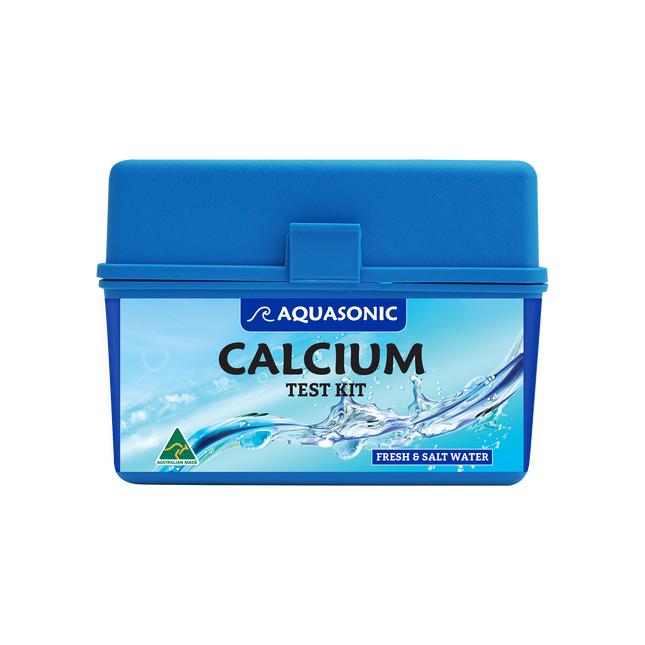
Aquasonic Aquasonic - Calcium Test Kit
What is Calcium? Calcium, scientific formula as Ca, is a very important element for most animal life, especially for corals and shellfish. It is the main cause of hard freshwater. Certain species of freshwater fish require certain levels of calcium. It is also the main ingredient in limestone, shellgrit and coral. Calcium, as an element, does not affect pH. Normal Levels In seawater the level of calcium at normal specific gravity is 383ppm. If seawater is used at a lower specific gravity than normal, levels of calcium will be proportionally less. For freshwater aquariums please check appropriate text books, however all Aquasonic Water Conditioners have exacting amounts of calcium to suit designated species. Calcium Build Up It is most important in both fresh and saltwater aquaria to set the levels of calcium when establishing the aquarium and then hold the appropriate levels by the addition, if necessary, of calcium in prescribed amounts. The use of shellgrit or coral rubble as a substrate or filter material can cause calcium levels to continually rise, to unacceptable levels. Reef Aquariums A maximum level of 450ppm is recommended for Reef Aquariums. If the level is taken above this then Carbonate Hardness levels, the main reason for stable pH, may be affected. The calcium would precipitate the carbonate as calcium carbonate. Calcium is used by calcareous algae, corals and shellfish, so in some situations, levels may require constant replenishment. To Set Calcium Levels In salt water, maintain levels with Aquasonic Ocean Nature Sea Salt. Normal specific gravity = 383ppm. Raise calcium in saltwater with Aquasonic Calcium-Sup. In freshwater, maintain levels with Aquasonic Water Conditioning Salts. Directions for Use: To determine Calcium in Salt or Fresh Water. Read Instructions Carefully Before Use. The test kit has a dual range. Measurements can be made in steps of 25ppm or 50ppm. Note: Seawater usually contains 350-450ppm of calcium. To Test in 25ppm: Rinse a clean test tube several times in the water to be tested and fill to the 10ml mark. Add 1 level scoop of Reagent A and 4 drops of Reagent B. Shake until powder dissolves (about 1-2 minutes). Solution will turn bright red if calcium is present. Immediately add Reagent C a drop at a time, swirling to mix after each addition. Keep count of the number of drops until colour changes to the end point (see chart) and multiply this by 25 to give calcium in ppm. To Test in 50ppm: Rinse a clean test tube several times in the water to be tested and fill to the 5ml mark. Add 1/2 scoop of Reagent A and 2 drops of Reagent B. Shake until powder dissolves (about 1 minute). Solution will turn bright red if calcium is present. Immediately add Reagent C a drop at a time, swirling to mix after each addition. Keep count of the number of drops until colour changes to the end point (see chart) and multiply by 50 to give calcium in ppm. *This colour chart provides a basic guide only. Colours may vary according to various water conditions.
$39.79 $31.00
-
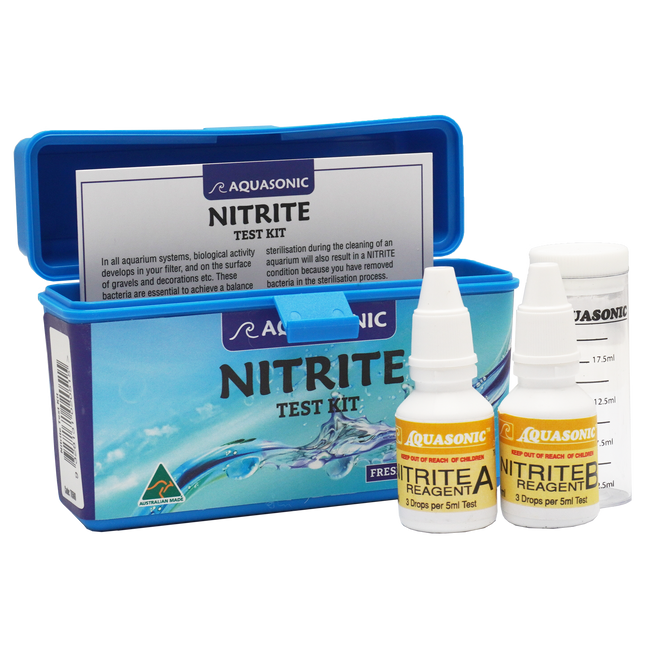
Aquasonic Aquasonic - Nitrite Test Kit
In all aquarium systems, biological activity develops in your filter, and on the surface of gravels and decorations etc. These bacteria are essential to achieve a balance in your aquarium and different types of bacteria need to be present in the right proportions to break down waste and deal with ammonia, nitrite and nitrate, which can all be harmful to your fish. Every time you change or add something in your tank, or you clean it, you potentially upset the balance because you are effectively removing some of these bacteria. The replacement of plants and coral or cleaning of filters, gravel or substrate, even in part, can also cause a NITRITE condition to re-occur, even in well-established aquariums. Complete sterilisation during the cleaning of an aquarium will also result in a NITRITE condition because you have removed bacteria in the sterilisation process.NITRITE is toxic to fish, even in quantities as small as 1ppm. If you are starting a new aquarium, it is recommended that you don’t put new fish into the system until a NITRITE reading of less than 1ppm is achieved (ideally zero). Recurring Nitrite Condition The biological activity in a filter may take as long as three months to develop fully, and in this time, due to increases in the number of fish, the NITRITE condition may re-occur. Evidence has shown, by lowering the pH to 7.5, the toxicity of NITRITE is minimised. If a system does develop nitrite on a continual basis, after it is fully conditioned, it may mean that the surface area of the biological filter is undersized, or the number of fish in the tank is too great. Assisting Biological Establishment To assist, ensure the temperature is steady, at or above 26 deg C, check the flow of water through the filters is well distributed and sufficient, and oxygen levels are adequate. When cleaning your filter media, use cold or lukewarm water only as hot water will kill the bacteria. To Break The Ammonia - Nitrite - Nitrate Cycle: Perform a water change Remove anything that can cause ammonia to form (e.g., dead organic matter or excess fish waste) from amongst the substrate (e.g., gravel cleaner) Use Aquasonic AMMO-GONE to neutralise ammonia in the system. The manual addition of live strains of nitrifying bacteria can also aid in kick starting the biological activity in the filter system. Directions for Use: Rinse the clean test tube and cap several times in the water to be tested. Fill the test tube to the 5ml mark with the water to be tested. Add 3 drops of Nitrite Reagent A. Add 3 drops of Nitrite Reagent B. Cap the test tube and invert twice. Wait a minimum of 2 minutes, but no longer than 3 minutes, to compare the test with the colour chart. After this time the test will continue to colour, but further colouration is irrelevant. Place the test tube on the white background of the colour chart and view vertically down the tube. The colour in the test tube is best viewed with natural light behind you. After completion of the test, wash the test tube carefully as a previous test could influence the next one.
$33.49 $26.00
-
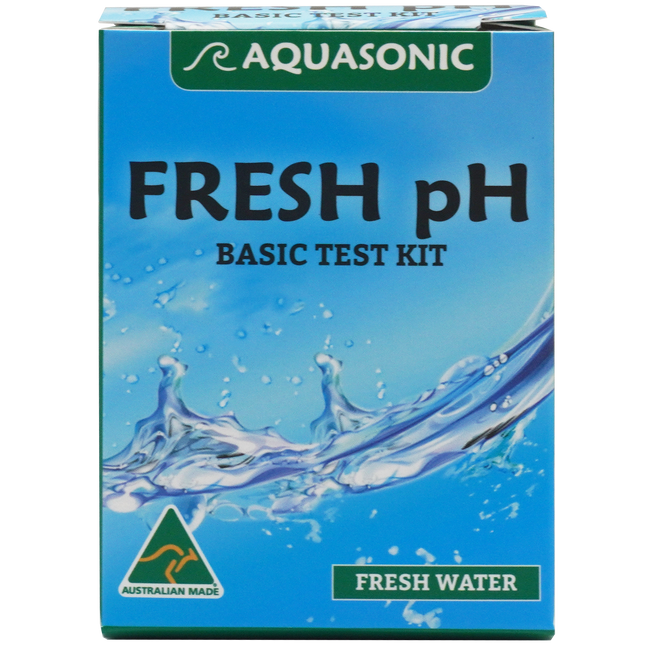
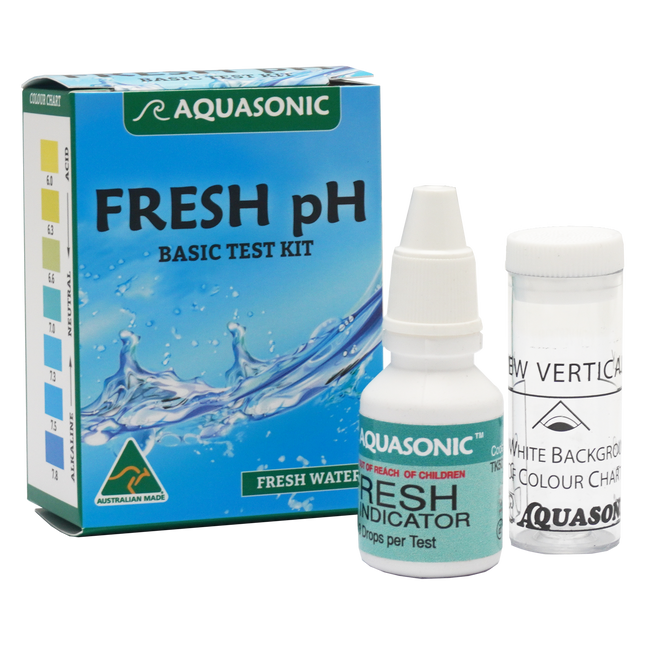
Aquasonic Aquasonic - Basic Freshwater pH Test Kit
What is pH? Technically it is the measurement of the hydrogen ion concentration of a given sample of water. From this measurement it can be determined whether the water is acid, neutral or alkaline. The scale extends from 0 to 14. A pH between 0 and 7 is termed acid, and a pH between 7 and 14 is termed alkaline. The indicator in this kit has a pH range from 6.0 to 7.8 and is therefore suitable for most freshwater aquaria. At or below pH 6.0 the test sample would turn yellow. At or above pH 7.8 the test sample would turn blue. Why pH Changes pH is not a constant factor and is subject to continual change due to influences like bacterial assimilation of waste causing acidity or calcium and magnesium compounds like shells or coral that cause alkalinity. Thus, under normal aquarium conditions, because of fish waste and unused food, the water would drift to acidity. Directions for Use: Rinse a clean test tube and cap several times in water to be tested. Fill to line (12.5ml) with water to be tested. Add 3 drops of Indicator solution Place the test tube on the white background of the colour chart, view vertically (down inside the test tube) with the light behind you. The colour in the test tube is best viewed with natural light. View immediately. Adjust pH slowly.
$17.59
-

Aquasonic Aquasonic - Amazon Water Conditioner (1L)
Water in rainforest rivers is conditioned by leaf tannins, humic and organic acids. Some leaching of ground minerals also occurs. These conditions are natural disease inhibitors for fish. The water is soft, usually below 50ppm hardness and a pH between 5.5 and 6.5. Amazon Water Conditioner recreates these same conditions in an aquarium. The result is brighter and more active fish, with a high resistance to disease. For aquarium use only. Keep out of reach of children. Directions for Use: 2ml per 10L of aquarium water. Retreatment only necessary when changing water. For Aquarium use only. For soft water species. To calculate approximate aquarium capacity: Multiply the length x width x water level height (in cm) and divide by 1,000 for litres.
$35.79


