


Fish - Health & wellbeing
-

Aquasonic Aquasonic - Formalin Malachite Solution (250ml)
White spot disease is a common fish parasite that can be introduced via new fish, plants, etc. These parasites appear as distinct small white spots (pin head size) on the fish's body and fins. Unless prompt action is taken fatalities will occur. Directions for Use: Not to be used on fish intended for human consumption. Ensure aquarium water is well aerated for the duration of the treatment. Activated carbon will remove this product from aquarium water resulting in ineffective treatment. Remove from filtration system for duration of treatment. This product contains a dye product which will stain if spilled. Dosage rates: Use at the rate of 5mL per 20 litres of aquarium water. Harmful to corals. Do not overdose. Repeat treatment after 3 days if necessary. For tetra species, baby fish and scaleless fish (loaches etc.), use at a reduced rate of 5mL per 40 litres of aquarium water. Storage: Store below 30C (Room Temperature). Replace lid tightly after use. Disposal: Dispose of empty container by wrapping with paper and putting in garbage. Safety Instructions: Will irritate the eyes. May irritate the skin. Avoid contact with eyes and skin. If product on skin, wash immediately with soap and water. If product in eyes, wash it out immediately with water. Wash hands after use. First Aid Instructions: If poisoning occurs, contact a doctor or Poisons Information Centre. Phone Australia (13 1126; New Zealand 0800 764 766). If swallowed, do not induce vomiting. Give a glass of water. If skin contact occurs, remove contaminated clothing and wash skin thoroughly. Remove from contaminated area. Apply artificial respiration if not breathing. If in eyes, holde yes open. flood with water for at least 15minutes and see a doctor. WARNING - Avoid contact with eyes. Avoid contact with skin. Avoid breathing vapor.
$22.29
-
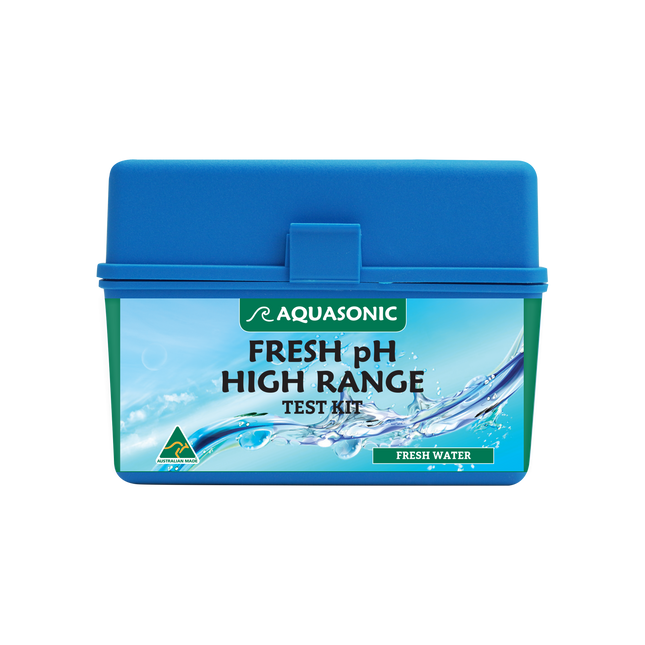
Aquasonic Aquasonic - Freshwater High Range pH Test Kit
Normal pH All Fish have an ideal pH range. Some fish, especially Cichlids from Africa’s Rift Lakes, require a higher pH than can be tested with a standard test kit. Certain events, namely biological filtration of an aquarium, tend to reduce the carbonate hardness value and therefore lower the pH. Also, certain influences like carbon dioxide, can affect the reading of the pH value. Biological Filtration The assimilation of waste by bacteria in the filter of an aquarium is an acidifying process and in time will reduce the carbonate hardness value of the water. As this occurs, the pH value will fall. pH Adjustment The basis of pH in the African Cichlid aquarium is Carbonate Hardness, also called kH or Alkalinity. This HIGH RANGE pH TEST KIT is best used in conjunction with the Aquasonic CARBONATE HARDNESS TEST KIT. Carbonate Hardness should be maintained over 100ppm, but no more than 260ppm. This will provide stable, high pH, helping your African Cichlids to thrive. Carbonate Hardness is quickly and easily increased using Aquasonic CARBONATE HARDNESS GENERATOR. If the carbonate hardness value of an aquarium is correct, yet pH values are not, then the influence of carbon dioxide should be considered. Directions for Use Rinse a clean test tube and cap several times in water to be tested. Fill the test tube to the 10mL mark Add 10 drops of pH indicator and swirl Place the test tube on the white background of the colour chart, view vertically with the light behind you. The colour in the test tube is best viewed with natural light. View immediately.
$31.09 $24.00
-

Aquasonic Aquasonic - Frystarter (100ml)
Aquasonic Frystarter has been specially formulated to feed newly hatched fry. It contains shrimp, fish, egg, vitamins and minerals, and has a variety of tiny food particles suitable for both livebearer and egglayer fry. When feeding, Frystarter stays in suspension longer, giving the fry a constant supply of food. Filtration should be maintained as an adequate safe guard against the risk of over feeding. Directions for Use: Feed the newly hatched fry 3-4 drops, 3 times daily dependant on aquarium size and fry numbers. Careful observation will enable you to achieve the correct dosage for your particular species of fish. To calculate approximate aquarium capacity: Multiply the length x width x water level height (in cm) and divide by 1,000 for litres.
$18.59
-

Aquasonic Aquasonic - Frystarter (1L)
Aquasonic Frystarter has been specially formulated to feed newly hatched fry. It contains shrimp, fish, egg, vitamins and minerals, and has a variety of tiny food particles suitable for both livebearer and egglayer fry. When feeding, Frystarter stays in suspension longer, giving the fry a constant supply of food. Filtration should be maintained as an adequate safe guard against the risk of over feeding. Directions for Use: Feed the newly hatched fry 3-4 drops, 3 times daily dependant on aquarium size and fry numbers. Careful observation will enable you to achieve the correct dosage for your particular species of fish. To calculate approximate aquarium capacity: Multiply the length x width x water level height (in cm) and divide by 1,000 for litres.
$56.29
-

Aquasonic Aquasonic - Frystarter (250ml)
Aquasonic Frystarter has been specially formulated to feed newly hatched fry. It contains shrimp, fish, egg, vitamins and minerals, and has a variety of tiny food particles suitable for both livebearer and egglayer fry. When feeding, Frystarter stays in suspension longer, giving the fry a constant supply of food. Filtration should be maintained as an adequate safe guard against the risk of over feeding. Directions for Use: Feed the newly hatched fry 3-4 drops, 3 times daily dependant on aquarium size and fry numbers. Careful observation will enable you to achieve the correct dosage for your particular species of fish. To calculate approximate aquarium capacity: Multiply the length x width x water level height (in cm) and divide by 1,000 for litres.
$26.99
-

Aquasonic Aquasonic - Frystarter (50ml)
Aquasonic Frystarter has been specially formulated to feed newly hatched fry. It contains shrimp, fish, egg, vitamins and minerals, and has a variety of tiny food particles suitable for both livebearer and egglayer fry. When feeding, Frystarter stays in suspension longer, giving the fry a constant supply of food. Filtration should be maintained as an adequate safe guard against the risk of over feeding. Directions for Use: Feed the newly hatched fry 3-4 drops, 3 times daily dependant on aquarium size and fry numbers. Careful observation will enable you to achieve the correct dosage for your particular species of fish. To calculate approximate aquarium capacity: Multiply the length x width x water level height (in cm) and divide by 1,000 for litres.
$13.39
-

Aquasonic Aquasonic - Fungonex (100ml)
Fungal diseases are common in freshwater fishes and are recognised by white or grey threads on the skin or fins which may thicken until they resemble tufts of cotton wool (pin head size) on the fished body and fins. Unless prompt action is taken fatalities will occur. Directions for Use: Do not use on fish intended for human consumption. A partial water change (25% capacity) is recommended before commencing treatment. Ensure aquarium water is well aerated and remove activated carbon from filtration system for the duration of treatment. Activated carbon will remove this product from the aquarium water resulting in ineffective. This product contains a dye product which will stain if spilled. Dose Rate: Add 5ml per 20 litres of aquarium water. For Tetra species, baby fish and scaleless fish (loaches, etc). Use at the reduced rate of 5ml per 40 litres of aquarium water. Repeat after 3 days. TO GIVE NUMBER OF LITRES: To calculate approximate tank capacity multiple length x width x water level height (all in cms) and divide by 1000 or litres. Disposal: Dispose of empty container by wrapping with paper and putting in garbage. Storage: Store below 30C (Room Temperature). Replace lid tightly after use. First Aid Instructions: For advice, contact the Poisons Information Centre (phone Australia 13 11 26; New Zealand 0800 764 766) or a doctor (at once).
$11.29
-

Aquasonic Aquasonic - Fungonex (1L)
Fungal diseases are common in freshwater fishes and are recognised by white or grey threads on the skin or fins which may thicken until they resemble tufts of cotton wool (pin head size) on the fished body and fins. Unless prompt action is taken fatalities will occur. Directions for Use: Do not use on fish intended for human consumption. A partial water change (25% capacity) is recommended before commencing treatment. Ensure aquarium water is well aerated and remove activated carbon from filtration system for the duration of treatment. Activated carbon will remove this product from the aquarium water resulting in ineffective. This product contains a dye product which will stain if spilled. Dose Rate: Add 5ml per 20 litres of aquarium water. For Tetra species, baby fish and scaleless fish (loaches, etc). Use at the reduced rate of 5ml per 40 litres of aquarium water. Repeat after 3 days. TO GIVE NUMBER OF LITRES: To calculate approximate tank capacity multiple length x width x water level height (all in cms) and divide by 1000 or litres. Disposal: Dispose of empty container by wrapping with paper and putting in garbage. Storage: Store below 30C (Room Temperature). Replace lid tightly after use. First Aid Instructions: For advice, contact the Poisons Information Centre (phone Australia 13 11 26; New Zealand 0800 764 766) or a doctor (at once).
$46.09 $35.00
-

Aquasonic Aquasonic - Fungonex (250ml)
Fungal diseases are common in freshwater fishes and are recognised by white or grey threads on the skin or fins which may thicken until they resemble tufts of cotton wool (pin head size) on the fished body and fins. Unless prompt action is taken fatalities will occur. Directions for Use: Do not use on fish intended for human consumption. A partial water change (25% capacity) is recommended before commencing treatment. Ensure aquarium water is well aerated and remove activated carbon from filtration system for the duration of treatment. Activated carbon will remove this product from the aquarium water resulting in ineffective. This product contains a dye product which will stain if spilled. Dose Rate: Add 5ml per 20 litres of aquarium water. For Tetra species, baby fish and scaleless fish (loaches, etc). Use at the reduced rate of 5ml per 40 litres of aquarium water. Repeat after 3 days. TO GIVE NUMBER OF LITRES: To calculate approximate tank capacity multiple length x width x water level height (all in cms) and divide by 1000 or litres. Disposal: Dispose of empty container by wrapping with paper and putting in garbage. Storage: Store below 30C (Room Temperature). Replace lid tightly after use. First Aid Instructions: For advice, contact the Poisons Information Centre (phone Australia 13 11 26; New Zealand 0800 764 766) or a doctor (at once).
$19.19
-

Aquasonic Aquasonic - Goldfish Conditioning Salts (2.5kg)
Aquasonic Goldfish Water Conditioning Salts have been formulated to re-create natural conditions in your aquarium or fish bowl. It contains the correct balance of salts, natural minerals and trace elements, plus bacterial and fungal inhibitors, to promote health and wellbeing. Use Goldfish Water Conditioning Salts with new aquarium water, when starting up or doing a water change. It will raise General Hardness by approx. 120ppm and Salinity (NaCI) by 225ppm. Further addition of salt (NaCI) is not recommended. Directions for Use: Add one level teaspoon (approx. 5gm) per 10L of water. Re-seal container when not in use. Do not re-dose without a water change. To calculate approximate aquarium capacity: Multiply the length x width x water level height (in cm) and divide by 1,000 for litres.
$32.09
-

Aquasonic Aquasonic - Goldfish Conditioning Salts (500g)
Aquasonic Goldfish Water Conditioning Salts have been formulated to re-create natural conditions in your aquarium or fish bowl. It contains the correct balance of salts, natural minerals and trace elements, plus bacterial and fungal inhibitors, to promote health and wellbeing. Use Goldfish Water Conditioning Salts with new aquarium water, when starting up or doing a water change. It will raise General Hardness by approx. 120ppm and Salinity (NaCI) by 225ppm. Further addition of salt (NaCI) is not recommended. Directions for Use: Add one level teaspoon (approx. 5gm) per 10L of water. Re-seal container when not in use. Do not re-dose without a water change. To calculate approximate aquarium capacity: Multiply the length x width x water level height (in cm) and divide by 1,000 for litres.
$14.09
-
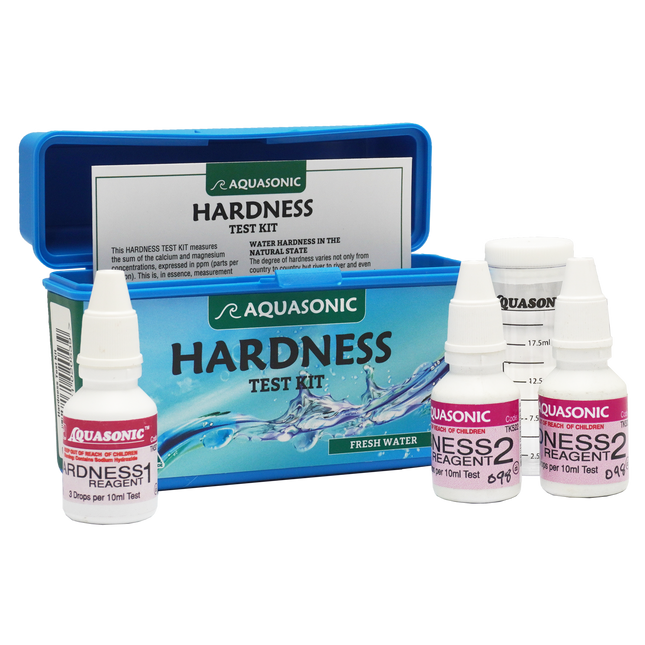
Aquasonic Aquasonic - Hardness GH Test Kit
This HARDNESS TEST KIT measures the sum of the calcium and magnesium concentrations, expressed in ppm (parts per million). This is, in essence, measurement of the permanent hardness of water, but the measurement may also contain some temporary hardness in the form of calcium dissolved by carbon dioxide in water. This form of temporary hardness is usually minimal. How Does Water Become Hard? Water hardness results from dissolved compounds of magnesium and calcium. With temporary hardness, magnesium and calcium are dissolved by carbon dioxidein water. This process can be reversed by removing the carbon dioxide, e.g. By boiling,or as aquatic plants use carbon dioxide. However, if the salts of magnesium or calciumare dissolved as a result of an acid present in water, the hardness becomes permanent. Water Hardness In The Natural State The degree of hardness varies not only from country to country but river to river and even the hardness in each river varies from season to season. Aquatic life have different requirements according to geographical location and though most fish can stand a great deal of variation in hardness, they do best at specific levels. Factors like breeding of a species, the colour of a species or even the inhibition of fungal diseases can be greatly enhanced by the hardness of water. Species Requirements Examples of fish that live at or below 150ppm are Angels, Corydoras, Catfish, Discus, Gouramis, Loaches, South American Tetras. Examples of fish that live between 150ppm and 300ppm are some Australian Natives, Guppies, Sword Tails, Mollies, Platties, and Goldfish. Examples of fish living above 300ppm and usually under 500ppm are African Cichlids, and Brackish water species. Directions for Use: The test kit has a dual range, measurements can be made in steps of 10ppm or 20ppm (ppm = parts per million). Complete the test within 5 minutes. To Test in 10ppm: Rinse a clean test tube several times in the water to be tested and fill to the 10 ml mark. Add 3 drops of Reagent 1, swirl to mix, then add 3 drops Reagent 2 and swirl to mix. Now add Reagent 3 (hold the bottle vertically), a drop at a time, swirl to mix before adding the next drop. Keep count of the drops. When the colour changes from red to blue the end point has been reached. Multiply the number of drops by 10 for the reading in parts per million. To Test in 20ppm: Rinse a clean test tube several times in the water to be tested and fill to the 5ml mark. Add 2 drops of Reagent 1, swirl to mix, then add 2 drops of Reagent 2 and swirl to mix. Now add Reagent 3 (hold the bottle vertically), a drop at a time, swirl to mix before adding the next drop. Keep count of the drops. When the colour changes from red to blue the end point has been reached. Multiply the number of drops by 20 for the reading in parts per million.
$39.79 $31.00


