
Aquasonic
-
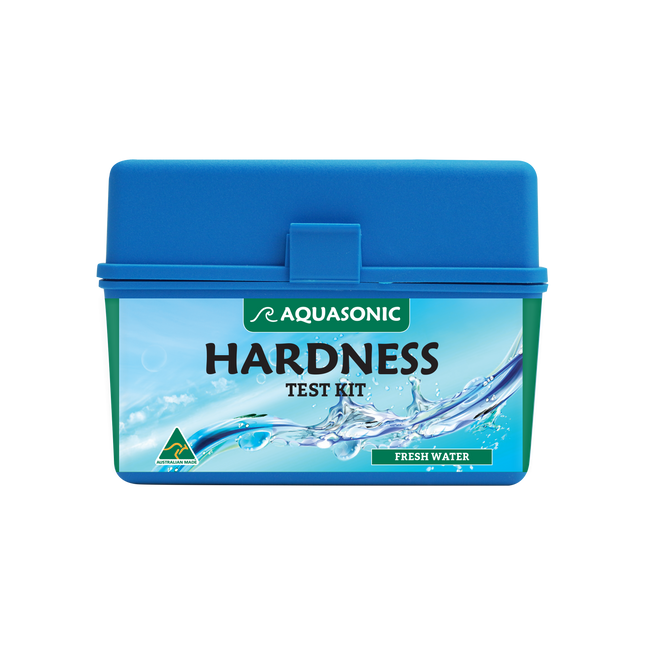
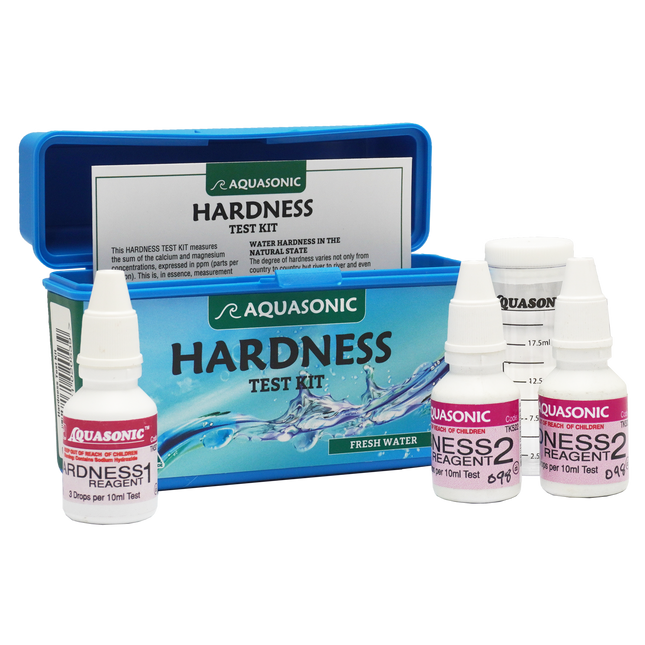
Aquasonic Aquasonic - Hardness GH Test Kit
This HARDNESS TEST KIT measures the sum of the calcium and magnesium concentrations, expressed in ppm (parts per million). This is, in essence, measurement of the permanent hardness of water, but the measurement may also contain some temporary hardness in the form of calcium dissolved by carbon dioxide in water. This form of temporary hardness is usually minimal. How Does Water Become Hard? Water hardness results from dissolved compounds of magnesium and calcium. With temporary hardness, magnesium and calcium are dissolved by carbon dioxidein water. This process can be reversed by removing the carbon dioxide, e.g. By boiling,or as aquatic plants use carbon dioxide. However, if the salts of magnesium or calciumare dissolved as a result of an acid present in water, the hardness becomes permanent. Water Hardness In The Natural State The degree of hardness varies not only from country to country but river to river and even the hardness in each river varies from season to season. Aquatic life have different requirements according to geographical location and though most fish can stand a great deal of variation in hardness, they do best at specific levels. Factors like breeding of a species, the colour of a species or even the inhibition of fungal diseases can be greatly enhanced by the hardness of water. Species Requirements Examples of fish that live at or below 150ppm are Angels, Corydoras, Catfish, Discus, Gouramis, Loaches, South American Tetras. Examples of fish that live between 150ppm and 300ppm are some Australian Natives, Guppies, Sword Tails, Mollies, Platties, and Goldfish. Examples of fish living above 300ppm and usually under 500ppm are African Cichlids, and Brackish water species. Directions for Use: The test kit has a dual range, measurements can be made in steps of 10ppm or 20ppm (ppm = parts per million). Complete the test within 5 minutes. To Test in 10ppm: Rinse a clean test tube several times in the water to be tested and fill to the 10 ml mark. Add 3 drops of Reagent 1, swirl to mix, then add 3 drops Reagent 2 and swirl to mix. Now add Reagent 3 (hold the bottle vertically), a drop at a time, swirl to mix before adding the next drop. Keep count of the drops. When the colour changes from red to blue the end point has been reached. Multiply the number of drops by 10 for the reading in parts per million. To Test in 20ppm: Rinse a clean test tube several times in the water to be tested and fill to the 5ml mark. Add 2 drops of Reagent 1, swirl to mix, then add 2 drops of Reagent 2 and swirl to mix. Now add Reagent 3 (hold the bottle vertically), a drop at a time, swirl to mix before adding the next drop. Keep count of the drops. When the colour changes from red to blue the end point has been reached. Multiply the number of drops by 20 for the reading in parts per million.
$39.79 $31.00
-
Aquasonic Aquasonic - Iron Test Kit
Growing Aquatic Plants In the natural state some river systems plants grow particularly well. These are the ones with certain water qualities and constant supplies of nutrients. Water that comes from limestone areas or springs (usually containing high levels of carbonates and/or carbon dioxide) support high levels of growth and plant varieties. Ponds or billabongs that contain rich sediment also support certain aquatic plants, growing in and out of water. The river systems however, that support the type of plants most suited to aquarium application are the ones with sustained levels of inorganic nutrients, one of the most important being iron. Plant Nutrients in the Aquarium Iron is considered the most important nutrient for aquatic plants. Recommended levels vary between 0.25 and 1.0ppm. Total levels of 2.0ppm may be harmful to both fish and plants. Aquatic plants can only use inorganic nutrients while they exist in a non-oxidized form. This fact presents a major problem when feeding aquatic plants ordinary fertilizers, because water and dissolved oxygen will oxidize certain important elements within hours. Furthermore, some of the nutrients supplied in plant foods, chiefly phosphates and nitrates, are unwanted in an aquarium and would most likely result in an algae problem. Aquasonic BASIC-GRO and DAILY-GRO have overcome the oxidization problem by specially formulating nutrients that only plants can use, nutrients made for aquatic application.
$39.79 $31.00
-
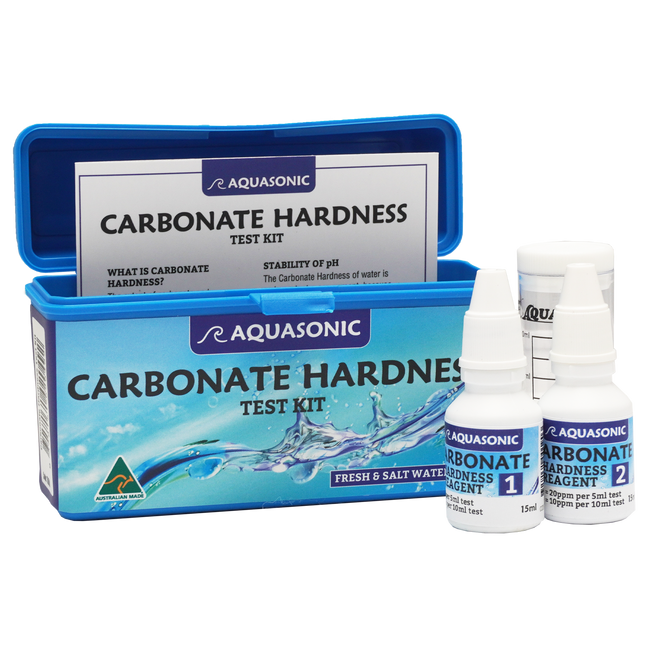
Aquasonic Aquasonic - Carbonate Hardness KH Test Kit
What is Carbonate Hardness? The extent of carbonate and bicarbonate contained in a sample of water is the Carbonate Hardness value of that sample. Carbonate Hardness affects all aquaria, both salt and fresh. It is called many names, according to the jargon of an industry or country of origin of the test kit, eg CARBONATE HARDNESS = ALKALINITY = kH (German) = ACID BINDING CAPACITY. Stability of pH The Carbonate Hardness of water is an important measurement, because the level of Carbonate Hardness is the basis for the value of the pH in a given sample of water. A strong Carbonate Hardness reserve in water can mean a very stable pH and the bonus of an alternative supply of carbon dioxide for plants and algae if supply runs short in an aquarium. This applies equally for marine or freshwater aquaria. Depletion of the Carbonate Hardness Reserve Acids which form as a result of the breakdown of waste products by bacteria (via biological filtration) is the most common way the carbonate hardness reserve is depleted. In aquariums with little or no carbonate hardness the pH is very unstable and can drop very quickly to acid. Raising Carbonate Harness Aquasonic Carbonate Hardness Generator Powder is recommended for fresh or salt water applications. 5g will raise the Carbonate Hardness of 100L of water by 20ppm. Directions for Use: The test kit has a dual range, which measures in steps of 10ppm or 20ppm (ppm = parts per million) To Test in 10ppm: Rinse the clean test tube several times in the water to be tested. Fill the test tube accurately to the 10mL mark. Add 2 drops REAGENT 1 and swirl to mix. A blue colour forms. Now add REAGENT 2 a drop at a time and swirl to mix. Keep count of the drops. As the end point is reached the test tube colour will change to green. Add 1 more drop to complete the change to yellow. Multiply the number of drops by 10 for the reading in ppm. To Test in 20ppm: Rinse the clean test tube several times in the water to be tested. Fill the test tube accurately to the 5mL mark. Add 1 drop of REAGENT 1 and swirl to mix. A blue colour forms. Add REAGENT 2 a drop at a time and swirl to mix. Keep count of the drops. When the colour changes to yellow the end point is reached. Multiply the number of drops by 20 for a reading in ppm. Note: Place the test tube on the white background of the colour chart with the light behind you. The colour in the test tube is best viewed with the natural light.
$31.09 $24.00
-

Aquasonic Aquasonic - Betta Conditioning Salt (100g)
Aquasonic Betta Water Conditioning Salts have been formulated to re-create natural conditions in your aquarium. It contains the correct balance of salts, natural minerals and trace elements, plus bacterial and fungal inhibitors, to promote health and wellbeing. Use Betta Water Conditioning Salts with new aquarium water, when starting up or doing a water change. It will raise General Hardness by approx. 80ppm and Salinity (NaCI) by 130ppm. Further addition of salt (NaCI) is not recommended. Direction for Use: Add 5g (1 level teaspoon) per 15L of water. Re-seal container when not in use. Do not redose without a water change. To calculate approximate aquarium capacity: Multiply the length x width x water level height (in cm) and divide by 1,000 for litres. For aquarium use only. Keep out of reach of children.
$9.79
-

Aquasonic Aquasonic - Riftlake Conditioning Salts (500g)
The African Rift Lakes have a unique water chemistry and African Cichlids thrive under these special conditions. Aquasonic Riftlake Conditioning Salts have been formulated to re-create this same water chemistry in your aquarium, creating natural conditions. It contains the correct balance of salts, natural minerals and trace elements, plus bacterial and fungal inhibitors, to promote health and wellbeing. Use Riftlake Water Conditioning Salts with new aquarium water, when starting up an aquarium or doing a water change. Do not use in water used to top up aquarium evaporation. Riftlake Water Conditioning Salts contains 11 natural salts and will raise the General Hardness by 300ppm and Salinity by 80ppm. A pH of 7.00 will rise to approx. 8.00. Directions for Use: Add 5g (1 level teaspoon) per 7L of water. Re-seal container when not in use. Do not redose without a water change. To calculate approximate aquarium capacity: Multiply the length x width x water level height (in cm) and divide by 1,000 for litres.
$14.09
-

Aquasonic Aquasonic - Livebearer Conditioning Salts (15kg)
Livebearers originate from various habitats, such as rainforest streams, brackish swamps and even salt water inlets. Livebearers tend to become susceptible to fungus and bacterial infections from water changes, tank movement and catching fish. Aquasonic Livebearer Water Conditioning Salts have been formulated to re-create natural conditions in your aquarium or fish bowl. It contains the correct balance of salts, natural minerals and trace elements, plus bacterial and fungal inhibitors, to promote health and wellbeing. Use Livebearers Water Conditioning Salts with new aquarium water, when starting up an aquarium or doing a water change. Do not use with water used to top up aquarium evaporation. It will raise General Hardness by approx. 110ppm, TDS will rise by 690ppm and Salinity by 660ppm. Further addition of common salt is not recommended. NOTE: This may affect some aquatic plants. Directions for Use: Add one level teaspoon (approx. 5gm) per 5L of water. Re-seal container when not in use. Do not redose without a water change. To calculate approximate aquarium capacity: Multiply the length x width x water level height (in cm) and divide by 1,000 for litres.
$138.69 $107.00
-

Aquasonic Aquasonic - Livebearer Conditioning Salts (500g)
Livebearers originate from various habitats, such as rainforest streams, brackish swamps and even salt water inlets. Livebearers tend to become susceptible to fungus and bacterial infections from water changes, tank movement and catching fish. Aquasonic Livebearer Water Conditioning Salts have been formulated to re-create natural conditions in your aquarium or fish bowl. It contains the correct balance of salts, natural minerals and trace elements, plus bacterial and fungal inhibitors, to promote health and wellbeing. Use Livebearers Water Conditioning Salts with new aquarium water, when starting up an aquarium or doing a water change. Do not use with water used to top up aquarium evaporation. It will raise General Hardness by approx. 110ppm, TDS will rise by 690ppm and Salinity by 660ppm. Further addition of common salt is not recommended. NOTE: This may affect some aquatic plants. Directions for Use: Add one level teaspoon (approx. 5gm) per 5L of water. Re-seal container when not in use. Do not redose without a water change. To calculate approximate aquarium capacity: Multiply the length x width x water level height (in cm) and divide by 1,000 for litres.
$14.09
-

Aquasonic Aquasonic - Tropical Conditioning Salts (500g)
Aquasonic Tropical Water Conditioning Salts have been formulated to re-create natural conditions in your aquarium. It contains the correct balance of salts, natural minerals and trace elements, plus bacterial and fungal inhibitors, to promote health and wellbeing. Use Tropical Water Conditioning Salts with new aquarium water, when starting up or doing a water change. It will raise General Hardness by approx. 80ppm and Salinity (NaCl) by 130ppm. Further addition of salt (NaCl) is not recommended. Directions for Use: Add 5g (1 level teaspoon) per 15L of water. Re-seal container when not in use. Do not redose without a water change. To calculate approximate aquarium capacity: Multiply the length x width x water level height (in cm) and divide by 1,000 for litres.
$14.09
-

$16.99
-

Aquasonic Aquasonic - Super Mat Filter Pad (1m x 2.1m)
The Aquasonic Super Mat is perfect for freshwater or saltwater and the ideal way to remove loose and floating debris from aquariums, ponds etc. The super mat does not compress easily and so debris does not accumulate just on the surface, thus blocking flow, but is collected deep in the mat as well. This greatly increases the life of the mat, the quantity of debris it can hold and time between changes. The super mat may be washed with a hose and re-used many times. Use the super mat for superior strength and long life. For use in: Power Filters Pre-FIlters Mini-Reef Filters Box Filters Canister Filters In-Tank Filters
$99.09 $76.00
-

Aquasonic Aquasonic - Ocean Nature Sea Salt (6kg)
Aquasonic Ocean Nature Sea Salt has been manufactured in Australia for more than 35 years. It is used in public aquariums, universities, aquaculture, commercial institutions and home aquariums. Ocean Nature is a safe and reliable formulation. Suitable for all marine fish and invertebrates from every sea and ocean.It contains no nitrates or phosphates, is fast dissolving and has the purest grade elements. For aquarium use only. Keep out of reach of children. MIXING GUIDE:- Specific gravity 1.022 at Temp 24C- 2kg of salt for 60L- 4kg of salt for 120L- 15kg of salt for 450L DIRECTIONS FOR USE: Fill a container with the appropriate quantity of water that you wish to mix. If using municipal supply, neutralise chlorine and/or chloramines using Aquasonic Power Water Purifier or Aquasonic Ammo-gone. Test the pH and adjust, if necessary, to a recommended level not less than 6.5 and not more than 7.3. Using the Mixing Guide, add the appropriate amount of Ocean Nature Sea Salt to the mixing container and immediately circulate or aerate the water thoroughly to dissolve the salt. Test the specific gravity (salinity) and adjust if necessary. The water will then be ready for use. To calculate approximate aquarium capacity: Multiply the length x width x water level height (in cm) and divide by 1,000 for litres. Ingredients: Sodium chloride, magnesium sulphate, magnesium chloride, calcium chloride, sodium bicarbonate, strontium chloride, lithium chloride, sodium molybdate, potassium iodide, aluminium sulphate, potassium bromide, cobaly sulphate, copper sulphate, zinc sulphate.
$34.79
-

$11.29


