


Aquarium Water Care & Treatments


Aquarium Water Care & Treatments
-

Aquasonic Aquasonic - Power Water Conditioner (1L)
Use Power Water Conditioner when starting up an aquarium to remove chlorine and chloramines which can be very harmful to aquarium fish. Power also contains elements that will remove heavy metals from the aquarium. Fungal inhibitors have also been added to help guard against infections. Directions for Use: 1ml per 10L of water. Use Power when starting up a new aquarium or when adding water for a water change. Premix Power with tap water before adding to aquariums containing fish. After using Power in freshwater aquariums always add Aquasonic Water Conditioning Salts to maintain that natural environment for your fish. In marine aquariums, use Power before the addition of Aquasonic Ocean Nature Sea Salt.
$27.39
-

API API - pH Proper 7.0 Powder Jar (250g)
API pH Proper 7.0 Powder Jar automatically sets and stabilizes the pH level in freshwater aquariums to 7.0 which is perfect for a mixed variety of tropical freshwater fish. It also removes toxic compounds from tap water such as chlorine, neutralizes chloramines, detoxifies heavy metals, and adds electrolytes, making tap water safe for fish. Use this aquarium treatment when setting up a new aquarium, adjusting pH, or changing water. pH in an aquarium can fluctuate due to fish waste, uneaten food and addition of tap water. It is recommended to test water for pH weekly. "pH is the measure of acidity of water, on a scale ranging from 0 to 14. A pH of 0 is the most acidic, while a pH of 14 is the most alkaline. Water with a pH of 7.0 is considered ""neutral"". Different geographies have different tap water conditions with different pH levels, while fish require a specific pH level to thrive. API Aquarium Treatment Supplies are designed to work in conjunction with each other to provide best results to control algae, promote healthy bacterial growth and help control and cure fish diseases and conditions such as ich and fin rot. They work to provide a safe, hospitable environment for fish such as tropical community fish, cichlids, goldfish and more. With API, you can spend more time admiring your fish, and less time scrubbing your tank. Make sure to use all products as directed in order to ensure the best results.
$37.99
-

API API - CO2 Booster (473ml)
Carbon deficiency is one of the leading causes of poor plant growth in aquariums. API® CO2 BOOSTER product adds essential liquid carbon for planted aquariums to fuel the photosynthetic process and turn light energy into new plant growth. API CO2 BOOSTER product supplies simple carbon compounds, and releases carbon to aquarium plants. Product may be used alone, or in conjunction with CO2 systems. Safe for use with freshwater fish, and will not alter pH. Instructions: Add 1 ml. per 10 gallons of aquarium water. Dose once a day. FAQs: Is the effectiveness of API CO2 BOOSTER™ product diminished by aeration and/or water circulation like CO2 gas? No, API CO2 BOOSTER product is an organic compound, not a gas. Is API CO2 BOOSTER™ a gas? No, API CO2 BOOSTER product is an organic compound, not a gas. Why can API CO2 BOOSTER™ product be dosed daily, but API LEAF ZONE™ plant fertilizer is only dosed weekly? API CO2 BOOSTER product breaks down chemically to supply carbon to plants within 24 hours, thus the reason for re-dosing every 24 hours. The organic compound slowly breaks down over the 24 hour period, allowing the plants to absorb what they need. Meanwhile, API LEAF ZONE plant fertilizer is stable in the water until the nutrients are utilized by the plants, allowing for a weekly dose. Can API CO2 BOOSTER™ product be used with shrimp? Yes, API CO2 BOOSTER product is safe for use with shrimp. Dosing directions should be followed. Does the effectiveness of API CO2 BOOSTER™ product change with the different levels of KH or any other water parameters? No, it does not. There is not enough chemical change in the water to effect water parameters. Will the required amount of API CO2 BOOSTER™ product vary based upon the number of plants in an aquarium? No, simply dose according to the instructions, and you’ll get great results.
$69.19 $53.00
-

API API - Algae Scraper for Acrylic Aquariums
The API ALGAE SCRAPER is an incredibly durable algae scraper with an 18” long handle to effectively clean acrylic aquarium walls and prevent user from getting too wet. This item scrapes and removes algae quickly and easily and may be used as frequently as needed. Do not use on dry surfaces. Rinse pad with tap water before and after use. Not for use on glass aquariums. FAQs Can I use an API ALGAE SCRAPER on any type of aquarium? No, API designs two separate scrapers for two different types of aquarium material: glass and acrylic. The appropriate scraper should be used on the corresponding tank to reduce the risk of scratching or damaging your aquarium. When should I use the API ALGAE SCRAPER? Use the API ALGAE SCRAPER to eliminate unsightly algae on aquarium walls as needed, but roughly once a week at a minimum to ensure tank cleanliness and clarity. Use any time algae accumulates on the walls of your aquarium.
$34.49
-


Prodibio Prodibio - Aqua-Turtle Nano 4 vials (120L)
QUA'TURTLE has been designed by PRODIBIO to fight effectively against the bad odours of the water of aqua terrariums hosting turtles. The bacteria and the natural ammonia blocker contained in AQUA'TURTLE allow to degrade the turtles' dejections in order to obtain a healthier water. PRODIBIO recommends using a filtration system in the aqua terrarium and changing the water regularly. The two products AQUA'TURTLE BACTER and AQUA'TURTLE ODOR, are to be used at the same time and at each water change. We recommend its use: The two products, Aqua’Turtle Odor and Aqua’Turtle Bacter are to be used at the same time and at each water change. Usage: 0-60L (1 vial)
$18.49
-

Aquasonic Aquasonic - pH Up (500g)
Aquasonic pH-Up is for reducing acidity. Made from high grade chemicals and works instantly. Treatment: Used to quickly raise pH Result: Will raise pH. Varies according to initial pH. Dose Rate: 1 teaspoon per 70 litres in a 12hr period. Use until desired pH is reached.
$14.79
-

Aquasonic Aquasonic - Carbonate Hardness Generator (2.5kg)
The Carbonate Hardness (kH) or also referred to as alkalinity of water is the basis for pH values. The stability of pH can be ensured by raising carbonate hardness levels without effect on general hardness.Acids produced in closed circuit aquaria continuously reduce the carbonate hardness levels. Carbonate Hardness Generator is a special blend of pH buffers that provide a sustained kH level for longer than if using just sodium bicarbonate. Prior raising of carbonate levels will avert drastic falls in pH resultant from these acids, acting to maintain a more stable pH. Directions for Use: 4g (approx. 1 teaspoon) per 100L of water or 40g per 1000L of water raises carbonate hardness levels by 20ppm. Caution pH levels may rise. It is not recommended to raise carbonate hardness values by more than 20ppm per day.To calculate approximate aquarium capacity: Multiply the length x width x height (in cm) and divide by 1,000 for litres.
$41.99
-

Aquasonic Aquasonic - Carbonate Hardness Generator (500g)
The Carbonate Hardness (kH) or also referred to as alkalinity of water is the basis for pH values. The stability of pH can be ensured by raising carbonate hardness levels without effect on general hardness.Acids produced in closed circuit aquaria continuously reduce the carbonate hardness levels. Carbonate Hardness Generator is a special blend of pH buffers that provide a sustained kH level for longer than if using just sodium bicarbonate. Prior raising of carbonate levels will avert drastic falls in pH resultant from these acids, acting to maintain a more stable pH. Directions for Use: 4g (approx. 1 teaspoon) per 100L of water or 40g per 1000L of water raises carbonate hardness levels by 20ppm. Caution pH levels may rise. It is not recommended to raise carbonate hardness values by more than 20ppm per day.To calculate approximate aquarium capacity: Multiply the length x width x height (in cm) and divide by 1,000 for litres.
$17.59
-

API API - Turtle Water Conditioner (237ml)
The API® Turtle Water Conditioner removes harmful chemicals from tap water, including chlorine, chloramines, and heavy metals, making it safe for aquatic reptiles and amphibians. Use when setting up an aquarium/vivarium, or when adding or changing water.
$34.59
-

Aquasonic Aquasonic - Power Water Conditioner (5L)
Use Power Water Conditioner when starting up an aquarium to remove chlorine and chloramines which can be very harmful to aquarium fish. Power also contains elements that will remove heavy metals from the aquarium. Fungal inhibitors have also been added to help guard against infections. Directions for Use: 1ml per 10L of water. Use Power when starting up a new aquarium or when adding water for a water change. Premix Power with tap water before adding to aquariums containing fish. After using Power in freshwater aquariums always add Aquasonic Water Conditioning Salts to maintain that natural environment for your fish. In marine aquariums, use Power before the addition of Aquasonic Ocean Nature Sea Salt.
$52.89
-

Aquasonic Aquasonic - Power Water Conditioner (250ml)
Use Power Water Conditioner when starting up an aquarium to remove chlorine and chloramines which can be very harmful to aquarium fish. Power also contains elements that will remove heavy metals from the aquarium. Fungal inhibitors have also been added to help guard against infections. Directions for Use: 1ml per 10L of water. Use Power when starting up a new aquarium or when adding water for a water change. Premix Power with tap water before adding to aquariums containing fish. After using Power in freshwater aquariums always add Aquasonic Water Conditioning Salts to maintain that natural environment for your fish. In marine aquariums, use Power before the addition of Aquasonic Ocean Nature Sea Salt.
$19.69
-
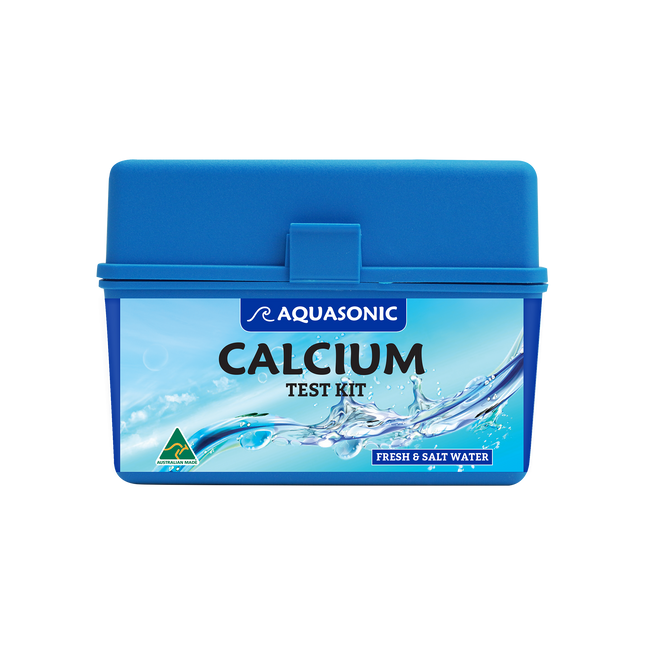
Aquasonic Aquasonic - Calcium Test Kit
What is Calcium? Calcium, scientific formula as Ca, is a very important element for most animal life, especially for corals and shellfish. It is the main cause of hard freshwater. Certain species of freshwater fish require certain levels of calcium. It is also the main ingredient in limestone, shellgrit and coral. Calcium, as an element, does not affect pH. Normal Levels In seawater the level of calcium at normal specific gravity is 383ppm. If seawater is used at a lower specific gravity than normal, levels of calcium will be proportionally less. For freshwater aquariums please check appropriate text books, however all Aquasonic Water Conditioners have exacting amounts of calcium to suit designated species. Calcium Build Up It is most important in both fresh and saltwater aquaria to set the levels of calcium when establishing the aquarium and then hold the appropriate levels by the addition, if necessary, of calcium in prescribed amounts. The use of shellgrit or coral rubble as a substrate or filter material can cause calcium levels to continually rise, to unacceptable levels. Reef Aquariums A maximum level of 450ppm is recommended for Reef Aquariums. If the level is taken above this then Carbonate Hardness levels, the main reason for stable pH, may be affected. The calcium would precipitate the carbonate as calcium carbonate. Calcium is used by calcareous algae, corals and shellfish, so in some situations, levels may require constant replenishment. To Set Calcium Levels In salt water, maintain levels with Aquasonic Ocean Nature Sea Salt. Normal specific gravity = 383ppm. Raise calcium in saltwater with Aquasonic Calcium-Sup. In freshwater, maintain levels with Aquasonic Water Conditioning Salts. Directions for Use: To determine Calcium in Salt or Fresh Water. Read Instructions Carefully Before Use. The test kit has a dual range. Measurements can be made in steps of 25ppm or 50ppm. Note: Seawater usually contains 350-450ppm of calcium. To Test in 25ppm: Rinse a clean test tube several times in the water to be tested and fill to the 10ml mark. Add 1 level scoop of Reagent A and 4 drops of Reagent B. Shake until powder dissolves (about 1-2 minutes). Solution will turn bright red if calcium is present. Immediately add Reagent C a drop at a time, swirling to mix after each addition. Keep count of the number of drops until colour changes to the end point (see chart) and multiply this by 25 to give calcium in ppm. To Test in 50ppm: Rinse a clean test tube several times in the water to be tested and fill to the 5ml mark. Add 1/2 scoop of Reagent A and 2 drops of Reagent B. Shake until powder dissolves (about 1 minute). Solution will turn bright red if calcium is present. Immediately add Reagent C a drop at a time, swirling to mix after each addition. Keep count of the number of drops until colour changes to the end point (see chart) and multiply by 50 to give calcium in ppm. *This colour chart provides a basic guide only. Colours may vary according to various water conditions.
$39.79 $31.00


