


Aquarium Water Care & Treatments


Aquarium Water Care & Treatments
-
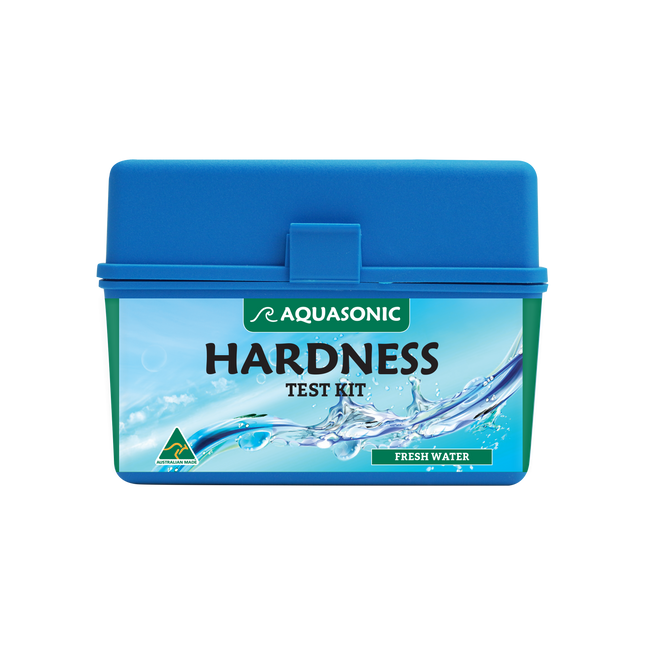
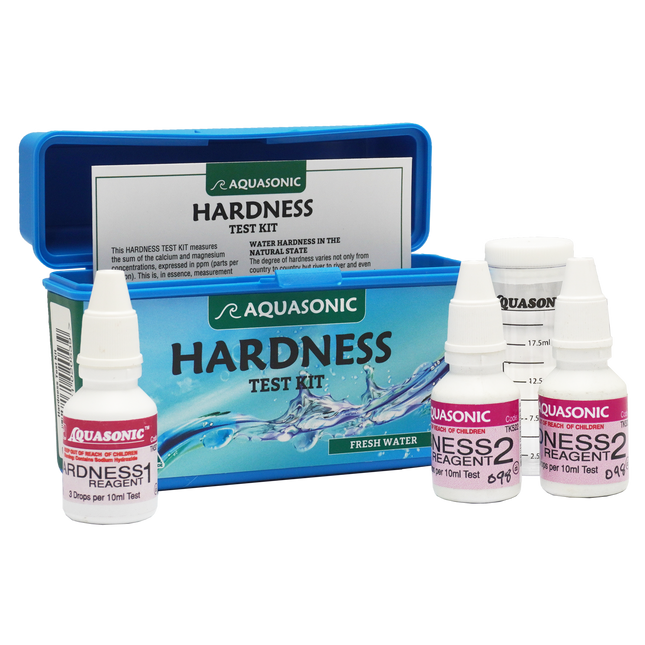
Aquasonic Aquasonic - Hardness GH Test Kit
This HARDNESS TEST KIT measures the sum of the calcium and magnesium concentrations, expressed in ppm (parts per million). This is, in essence, measurement of the permanent hardness of water, but the measurement may also contain some temporary hardness in the form of calcium dissolved by carbon dioxide in water. This form of temporary hardness is usually minimal. How Does Water Become Hard? Water hardness results from dissolved compounds of magnesium and calcium. With temporary hardness, magnesium and calcium are dissolved by carbon dioxidein water. This process can be reversed by removing the carbon dioxide, e.g. By boiling,or as aquatic plants use carbon dioxide. However, if the salts of magnesium or calciumare dissolved as a result of an acid present in water, the hardness becomes permanent. Water Hardness In The Natural State The degree of hardness varies not only from country to country but river to river and even the hardness in each river varies from season to season. Aquatic life have different requirements according to geographical location and though most fish can stand a great deal of variation in hardness, they do best at specific levels. Factors like breeding of a species, the colour of a species or even the inhibition of fungal diseases can be greatly enhanced by the hardness of water. Species Requirements Examples of fish that live at or below 150ppm are Angels, Corydoras, Catfish, Discus, Gouramis, Loaches, South American Tetras. Examples of fish that live between 150ppm and 300ppm are some Australian Natives, Guppies, Sword Tails, Mollies, Platties, and Goldfish. Examples of fish living above 300ppm and usually under 500ppm are African Cichlids, and Brackish water species. Directions for Use: The test kit has a dual range, measurements can be made in steps of 10ppm or 20ppm (ppm = parts per million). Complete the test within 5 minutes. To Test in 10ppm: Rinse a clean test tube several times in the water to be tested and fill to the 10 ml mark. Add 3 drops of Reagent 1, swirl to mix, then add 3 drops Reagent 2 and swirl to mix. Now add Reagent 3 (hold the bottle vertically), a drop at a time, swirl to mix before adding the next drop. Keep count of the drops. When the colour changes from red to blue the end point has been reached. Multiply the number of drops by 10 for the reading in parts per million. To Test in 20ppm: Rinse a clean test tube several times in the water to be tested and fill to the 5ml mark. Add 2 drops of Reagent 1, swirl to mix, then add 2 drops of Reagent 2 and swirl to mix. Now add Reagent 3 (hold the bottle vertically), a drop at a time, swirl to mix before adding the next drop. Keep count of the drops. When the colour changes from red to blue the end point has been reached. Multiply the number of drops by 20 for the reading in parts per million.
$39.79 $31.00
-
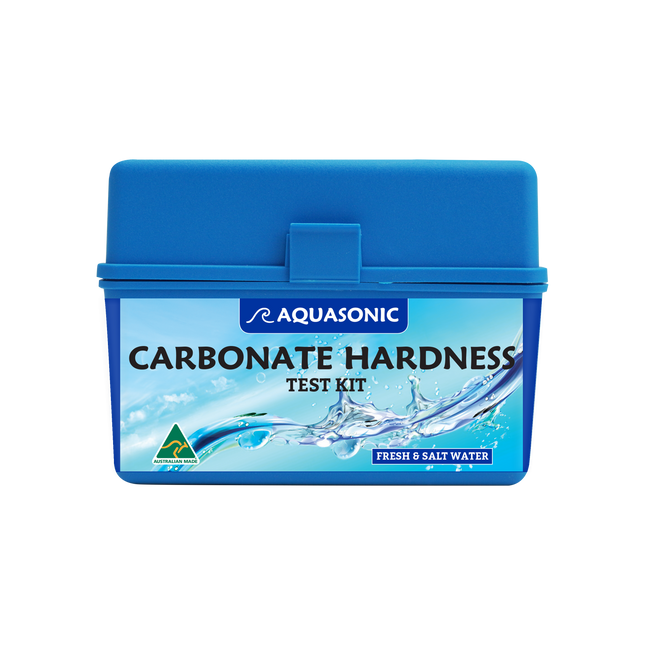
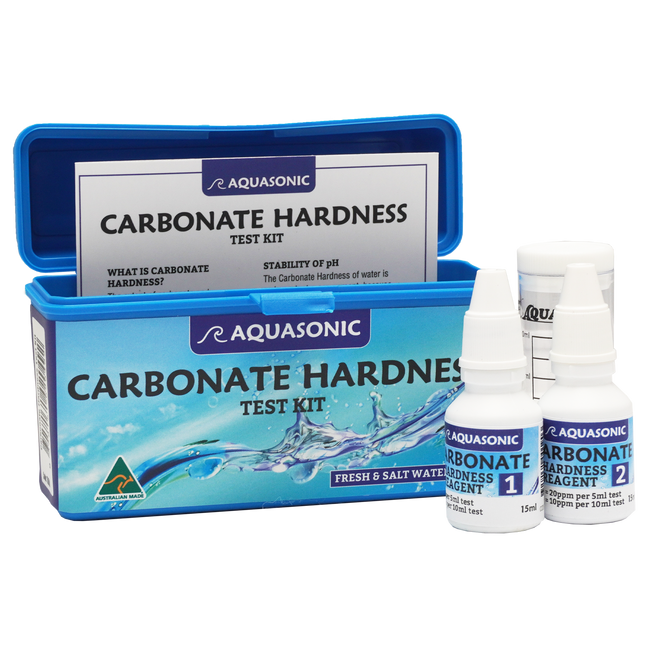
Aquasonic Aquasonic - Carbonate Hardness KH Test Kit
What is Carbonate Hardness? The extent of carbonate and bicarbonate contained in a sample of water is the Carbonate Hardness value of that sample. Carbonate Hardness affects all aquaria, both salt and fresh. It is called many names, according to the jargon of an industry or country of origin of the test kit, eg CARBONATE HARDNESS = ALKALINITY = kH (German) = ACID BINDING CAPACITY. Stability of pH The Carbonate Hardness of water is an important measurement, because the level of Carbonate Hardness is the basis for the value of the pH in a given sample of water. A strong Carbonate Hardness reserve in water can mean a very stable pH and the bonus of an alternative supply of carbon dioxide for plants and algae if supply runs short in an aquarium. This applies equally for marine or freshwater aquaria. Depletion of the Carbonate Hardness Reserve Acids which form as a result of the breakdown of waste products by bacteria (via biological filtration) is the most common way the carbonate hardness reserve is depleted. In aquariums with little or no carbonate hardness the pH is very unstable and can drop very quickly to acid. Raising Carbonate Harness Aquasonic Carbonate Hardness Generator Powder is recommended for fresh or salt water applications. 5g will raise the Carbonate Hardness of 100L of water by 20ppm. Directions for Use: The test kit has a dual range, which measures in steps of 10ppm or 20ppm (ppm = parts per million) To Test in 10ppm: Rinse the clean test tube several times in the water to be tested. Fill the test tube accurately to the 10mL mark. Add 2 drops REAGENT 1 and swirl to mix. A blue colour forms. Now add REAGENT 2 a drop at a time and swirl to mix. Keep count of the drops. As the end point is reached the test tube colour will change to green. Add 1 more drop to complete the change to yellow. Multiply the number of drops by 10 for the reading in ppm. To Test in 20ppm: Rinse the clean test tube several times in the water to be tested. Fill the test tube accurately to the 5mL mark. Add 1 drop of REAGENT 1 and swirl to mix. A blue colour forms. Add REAGENT 2 a drop at a time and swirl to mix. Keep count of the drops. When the colour changes to yellow the end point is reached. Multiply the number of drops by 20 for a reading in ppm. Note: Place the test tube on the white background of the colour chart with the light behind you. The colour in the test tube is best viewed with the natural light.
$31.09 $24.00
-
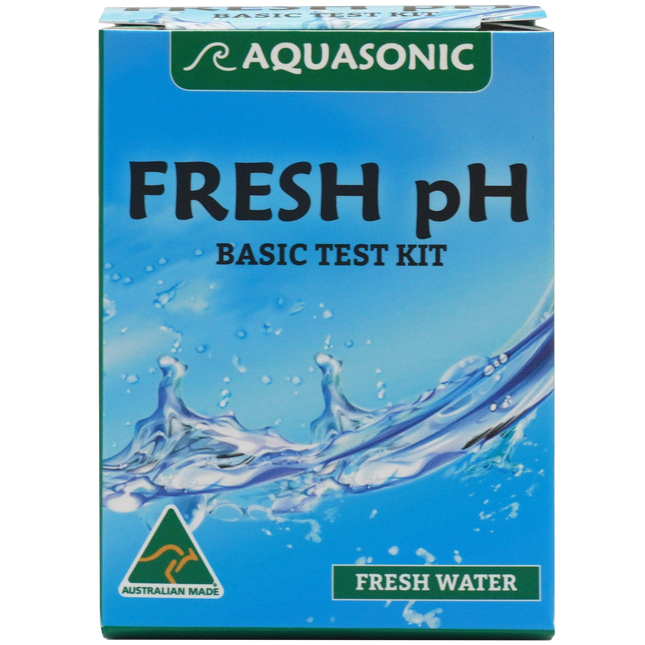
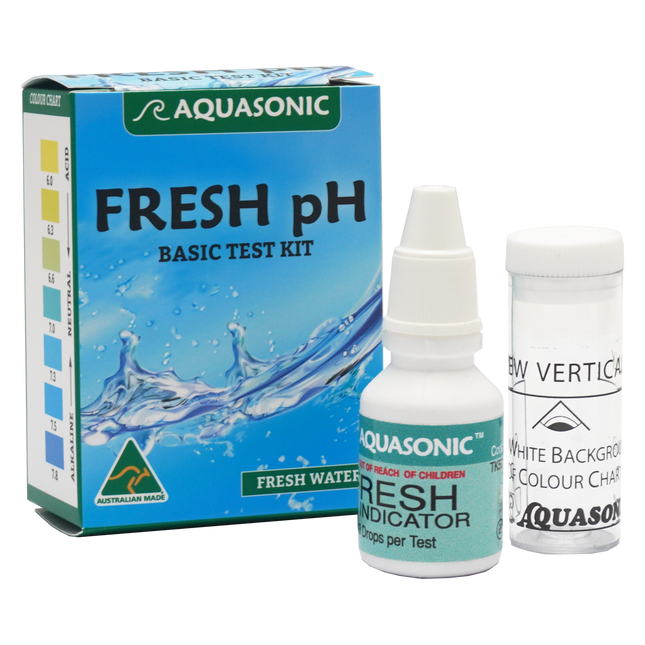
Aquasonic Aquasonic - Basic Freshwater pH Test Kit
What is pH? Technically it is the measurement of the hydrogen ion concentration of a given sample of water. From this measurement it can be determined whether the water is acid, neutral or alkaline. The scale extends from 0 to 14. A pH between 0 and 7 is termed acid, and a pH between 7 and 14 is termed alkaline. The indicator in this kit has a pH range from 6.0 to 7.8 and is therefore suitable for most freshwater aquaria. At or below pH 6.0 the test sample would turn yellow. At or above pH 7.8 the test sample would turn blue. Why pH Changes pH is not a constant factor and is subject to continual change due to influences like bacterial assimilation of waste causing acidity or calcium and magnesium compounds like shells or coral that cause alkalinity. Thus, under normal aquarium conditions, because of fish waste and unused food, the water would drift to acidity. Directions for Use: Rinse a clean test tube and cap several times in water to be tested. Fill to line (12.5ml) with water to be tested. Add 3 drops of Indicator solution Place the test tube on the white background of the colour chart, view vertically (down inside the test tube) with the light behind you. The colour in the test tube is best viewed with natural light. View immediately. Adjust pH slowly.
$17.59
-

Aquasonic Aquasonic - Amazon Water Conditioner (1L)
Water in rainforest rivers is conditioned by leaf tannins, humic and organic acids. Some leaching of ground minerals also occurs. These conditions are natural disease inhibitors for fish. The water is soft, usually below 50ppm hardness and a pH between 5.5 and 6.5. Amazon Water Conditioner recreates these same conditions in an aquarium. The result is brighter and more active fish, with a high resistance to disease. For aquarium use only. Keep out of reach of children. Directions for Use: 2ml per 10L of aquarium water. Retreatment only necessary when changing water. For Aquarium use only. For soft water species. To calculate approximate aquarium capacity: Multiply the length x width x water level height (in cm) and divide by 1,000 for litres.
$35.79
-

API API - Pond Care Aquatic Plant Tabs (25pk)
AQUATIC PLANT FOOD TABLETS provide essential nutrients and trace elements needed by pond plants to ensure non-stop blooming. Tablets contain iron for lush, green growth and boron to promote flower formation. It keeps water lilies blooming all season long, stimulates lush foliage and beautiful blooms of all aquatic pond plants (hardy tropical plants and marginal and bog plants). Feed plants once a month until the water temperature reaches 70⁰F, then feed twice a month. Stop using Aquatic plant food tablets when the water temperature drops below 60⁰F. Use one tablet for every gallon of soil. Push the tablet into the plant soil, 3 inches from the crown of the plant and 3 to 6 inches deep into the soil. Do API AQUATIC PLANT FOOD TABLETS need to be inserted into soil to work? API AQUATIC PLANT FOOD TABLETS can just be dropped in your water or inserted into the soil for optimal results. Can I use API AQUATIC PLANT FOOD TABLETS in an aquarium? Yes, API AQUATIC PLANT FOOD TABLETS may be used in an aquarium.
$19.29
-

API API - Pond Care Accu Clear (473ml)
API® POND ACCU-CLEAR water clarifier works to establish and maintain crystal-clear pond water, quickly clearing murkiness and helping your water filter to function more efficiently. ACCU-CLEAR water clarifier works by causing tiny, suspended cloud particles in water to clump together, which then quickly fall to the bottom of your pond. Recommended for use with POND-ZYME™ SLUDGE DESTROYER™ bacterial cleaner or POND ECOFIX™ SLUDGE DESTROYER™ bacterial cleaner for unparalleled pond cleanliness. Add 0.25 cup per 600 gallons of pond water. If second dose is necessary, wait 24 hours. Is API POND ACCU-CLEAR™ water clarifier safe around pets? API POND ACCU-CLEAR water clarifier is for ornamental pond use only, but is safe for fish, pond plants, and surrounding wildlife when used as directed.
$56.99
-

API API - Saltwater Master Test Kit
API - Saltwater Master Test Kit protects marine fish and invertebrates from unsafe water conditions. Fish waste, uneaten food, plant refuse and other organic compounds can create harmful levels of ammonia, nitrite and nitrate as well as cause drastic fluctuations in pH. These unhealthy conditions can result in fish stress, gill and tissue damage and even death. The API Saltwater Master Test Kit accurately measures these four saltwater parameters that are key to keeping your aquarium healthy. It includes six bottles of liquid test reagent, four glass test tubes with snap-tight caps, a holding tray and a step-by-step instruction booklet with information on how to correct unsafe water conditions. Simply fill a clean test tube with 5 ml of water, add the appropriate test drops and compare results with the colour chart. Then follow the recommendations to modify conditions if action is needed. For over 50 years, API has been creating innovative, research-driven solutions that make it easier to care for your fish and aquarium. API Aquarium Treatment Supplies are designed to work in conjunction with each other to provide best results to control algae, promote healthy bacterial growth and help control and cure fish diseases and conditions such as ich and fin rot. They work to provide a safe, hospitable environment for fish such as tropical community fish, cichlids, goldfish and more. With API, you can spend more time admiring your fish, and less time scrubbing your tank. Make sure to use all products as directed in order to ensure the best results.
$135.89 $105.00
-


Prodibio Prodibio - Start Up Nano 4 vials (120L)
START UP is used to easily and safely start a freshwater or saltwater aquarium.It allows the acclimatization of fish in their new habitat. START UP accelerates the nitrogen cycle by combining STOP AMMO START, which traps ammonia, and BIODIGEST START, which contains natural, living, purifying bacteria. They contribute to the biological filtration of the aquarium. The introduction of 1/3 of the most robust fish is possible after about 4 hours in fresh water and 12 hours in sea water. We recommend its use: When starting any new aquarium. When renovating an aquarium. Usage: 60-120L (4 blisters)
$25.79
-


Prodibio Prodibio - Start Up Nano 2 vials (60L)
START UP is used to easily and safely start a freshwater or saltwater aquarium. It allows the acclimatization of fish in their new habitat. START UP accelerates the nitrogen cycle by combining STOP AMMO START, which traps ammonia, and BIODIGEST START, which contains natural, living, purifying bacteria. They contribute to the biological filtration of the aquarium. The introduction of 1/3 of the most robust fish is possible after about 4 hours in fresh water and 12 hours in sea water. We recommend its use: When starting any new aquarium. When renovating an aquarium. Usage: 0-60L (2 blisters)
$16.99
-

Marina Marina - Betta Water Conditioner (25ml)
Marina Betta Pure Water Conditioner makes tap water safe for your betta by removing harmful chlorine, chloramine and heavy metals found in tap water. Protects fish with a healthy slime coat. Use for new aquarium setups, when adding new water, or during fish transport.
$9.29
-

Aquasonic Aquasonic - Carbonate Hardness Generator (100g)
The Carbonate Hardness (kH) or also referred to as alkalinity of water is the basis for pH values. The stability of pH can be ensured by raising carbonate hardness levels without effect on general hardness.Acids produced in closed circuit aquaria continuously reduce the carbonate hardness levels. Carbonate Hardness Generator is a special blend of pH buffers that provide a sustained kH level for longer than if using just sodium bicarbonate. Prior raising of carbonate levels will avert drastic falls in pH resultant from these acids, acting to maintain a more stable pH. Directions for Use: 4g (approx. 1 teaspoon) per 100L of water or 40g per 1000L of water raises carbonate hardness levels by 20ppm. Caution pH levels may rise. It is not recommended to raise carbonate hardness values by more than 20ppm per day.To calculate approximate aquarium capacity: Multiply the length x width x height (in cm) and divide by 1,000 for litres.
$13.39
-

API API - Turtle Water Conditioner (118ml)
The API® Turtle Water Conditioner removes harmful chemicals from tap water, including chlorine, chloramines, and heavy metals, making it safe for aquatic reptiles and amphibians. Use when setting up an aquarium/vivarium, or when adding or changing water.
$22.89


