
Aquasonic
-

Aquasonic Aquasonic - Magna Clear (1L)
Magna Clear will clear water in aquariums when water is cloudy or where gravel has dirtied the water. Ideal for new aquariums. Excellent for fish bowls. Magna Clear will assist filters in your aquarium to work more efficiently and also helps clear aquariums with insufficient filtration and bowls with no filtration. Magna Clear settles and collects suspended organic matter, which can then be easily siphoned off leaving your aquarium clear. Directions for Use: 1ml per 20ml, (3 drops per 4L) for clearing cloudy or new aquariums.1ml per 40ml for improved filtration or to settle suspended organic matter. Important: Dilute calculated dosage in a small quantity of water before dispersal into the aquarium. Airstones and filtration will help the dispersion. Only gentle agitation is required. Repeat if necessary after 24 hours. Do not use more than twice in 14 days.
$37.19
-

Aquasonic Aquasonic - Protech (100ml)
Water changes can be very tough on aquarium fish, often resulting in disease or even fatality. Protech has been formulated to effectively assist fish with recovery after a water change, transport or handling. Protech replaces slime coating and makes fish feel well by providing a powerful vitamin mix including: B1, B2, B6, B12, E, and A. This enables the fish to fight off disease and start feeding again quickly. Use during and after transport, after a water change, after any handling of fish or simply as a vitamin supplement. Fungal inhibitors have also been added to help guard against infections. Directions for Use: 1ml per 20L for general use. For fish in a poor state use treatments as high as 1ml per 5L to assist in faster recovery. For transport use general dose rates. 1ml - approx. 15 drops. To calculate approximate aquarium capacity: Multiply the length x width x water level height (in cm) and divide by 1,000 for litres.
$11.99
-

Aquasonic Aquasonic - Ammo-Gone Water Conditioner (250ml)
Ammo-gone will neutralise ammonia, chlorine and chloramines, in fresh or salt water. When neutralising ammonia, use an Aquasonic Ammonia Test Kit to determine the level of ammonia present and the increase or decrease the dosage proportionally to neutralise it in one dose. In areas where ammonia or chloramines are a problem in tap water, Ammo-gone is essential. Use each time a new aquarium is installed, when water changes are made or transporting fish. If mixing salt water for marine aquariums, use Ammo-gone. Following the use of of Ammo-gone, use Aquasonic Water Conditioning Salts to create that ideal habitat. For trouble free saltwater, use Aquasonic Ocean Natures Sea Salt. For aquarium use only. Keep out of reach of children. Directions for Use: To neutralise chlorine or chloramines use 5ml per 20ml of water. To neutralise ammonia, 5ml per 20l of water neutralise 0.75ppm ammonia. Ammo-gone has no effect on marine salts and can be use with invertebrates. Always treat new water before adding to your aquarium. Note: Ammo-gone may bleach clothing if accidentally spilled. Ammo-gone may cause faulty readings with ammonia test kits that use Nessler's reagents.
$22.49
-

Aquasonic Aquasonic - Power Water Conditioner (5L)
Use Power Water Conditioner when starting up an aquarium to remove chlorine and chloramines which can be very harmful to aquarium fish. Power also contains elements that will remove heavy metals from the aquarium. Fungal inhibitors have also been added to help guard against infections. Directions for Use: 1ml per 10L of water. Use Power when starting up a new aquarium or when adding water for a water change. Premix Power with tap water before adding to aquariums containing fish. After using Power in freshwater aquariums always add Aquasonic Water Conditioning Salts to maintain that natural environment for your fish. In marine aquariums, use Power before the addition of Aquasonic Ocean Nature Sea Salt.
$73.59 $57.00
-

Aquasonic Aquasonic - Power Water Conditioner (100ml)
Use Power Water Conditioner when starting up an aquarium to remove chlorine and chloramines which can be very harmful to aquarium fish. Power also contains elements that will remove heavy metals from the aquarium. Fungal inhibitors have also been added to help guard against infections. Directions for Use: 1ml per 10L of water. Use Power when starting up a new aquarium or when adding water for a water change. Premix Power with tap water before adding to aquariums containing fish. After using Power in freshwater aquariums always add Aquasonic Water Conditioning Salts to maintain that natural environment for your fish. In marine aquariums, use Power before the addition of Aquasonic Ocean Nature Sea Salt.
$13.39
-

Aquasonic Aquasonic - Water Purifier (250ml)
Most water supplies such as tap water, are chlorinated. Chlorine can be extremely harmful to aquarium fish. Water Purifier is the most important supplement for the aquarist. Water Purifier will effectively neutralise chlorine and chloramines in tap water immediately, making water safe for aquarium use. Following the use of Aquasonic Water Purifier, use Aquasonic Water Conditioning Salts to create an ideal habitat for fish and aquatic plants. For trouble free saltwater, use Aquasonic Ocean Nature Sea Salt, adding the Water Purifier before mixing salt with water. Directions for Use: 1ml per 10ml of water.Add to new aquarium water or any water to be added to the aquarium. Pre-mix Water Purifier with tap water before adding to aquariums containing fish. To calculate approximate aquarium capacity: Multiply the length x width x water level height (in cm) and divide by 1,000 for litres.
$19.69
-
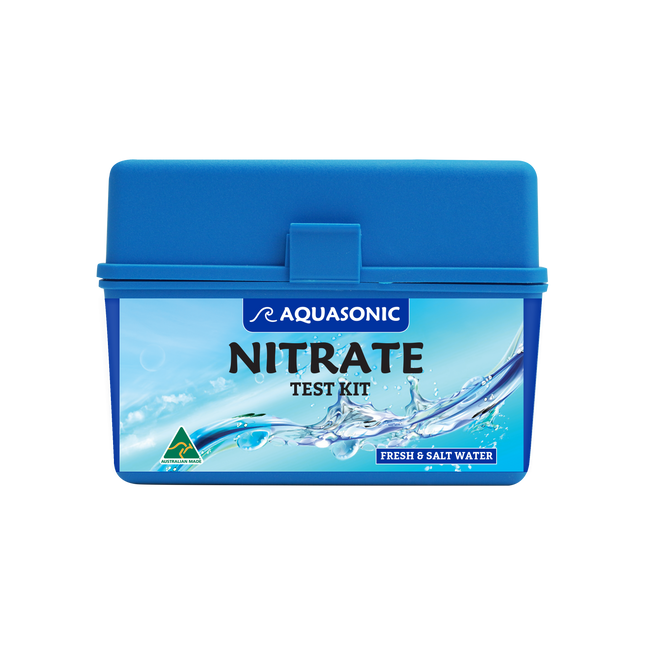
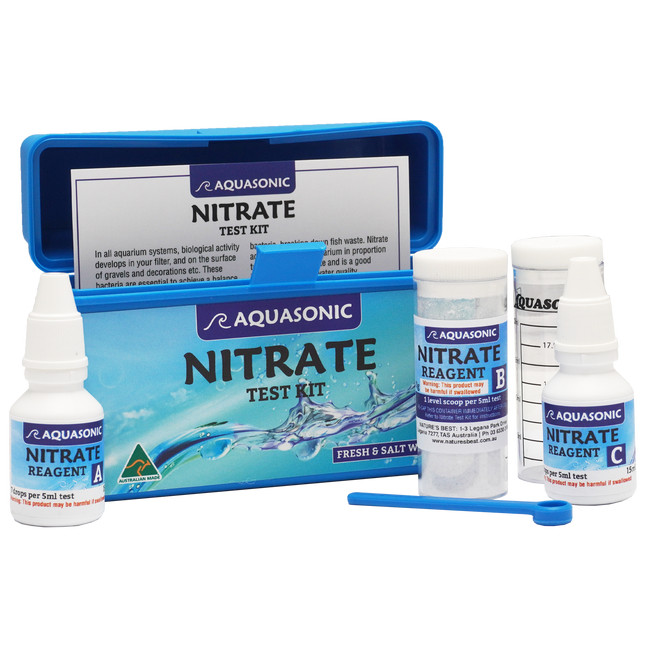
Aquasonic Aquasonic - Nitrate Test Kit
In all aquarium systems, biological activity develops in your filter, and on the surface of gravels and decorations etc. These bacteria are essential to achieve a balance in your aquarium and different types of bacteria need to be present in the right proportions to break down waste and deal with ammonia, nitrite and nitrate, which can all be harmful to your fish. Every time you change or add something in your tank, or you clean it, you potentially upset the balance because you are effectively removing some of this bacteria. Nitrate Nitrate ions are produced as a result of biological action occurring mainly in your aquarium filter system. It is the residue of a chain reaction by aerobic bacteria, breaking down fish waste. Nitrate accumulates in an aquarium in proportion to the stock load waste and is a good indicator of general water quality. Permissible Nitrate Levels As nitrate levels increase, water quality decreases. The quantity of permissible nitrate varies with the particular aquatic life being cultured. a) For marine systems culturing fish, acceptable levels are 20ppm to 40ppm. Many species of marine fish will accept higher levels of 80ppm to 100ppm without apparent effect on their health. But it is recommended that when levels climb above 40ppm steps should be taken to lower the nitrate to avoid stress. b) For reef systems culturing invertebrates, much lower levels of nitrate are acceptable. A level of 5ppm or less is optimum. Again, many invertebrates will accept higher levels but once these levels climb above 20ppm many of the more sensitive invertebrates will be irreparably damaged. It has been shown that small quantities of around 5ppm of nitrate are of assistance in culturing marine plants. Nitrate tests on reef systems should occur weekly and levels should be kept below 10ppm. c) Freshwater fish. Tolerance to nitrate with freshwater fish is higher than saltwater species. Some delicate species will tolerate around 50ppm, but some species will tolerate far higher levels. It is recommended that as nitrate levels approach 50ppm steps should be taken to reduce the level. Lowering Nitrate The easiest method to lower nitrate is to change water. Regular water changes should ensure that the nitrate levels stay within acceptable limits. Recommended minimum water change requirements are 25% per month. If water changes do not keep the nitrate at acceptable levels, then perhaps the number of fish in the tank is too great for your aquarium system, so reduce the number of fish. Denitrification filters can lower nitrate successfully, but this must be closely monitored to avoid dangerous gases that can harm aquarium inhabitants. Marine plants and algae can use some nitrate as nutrients and are a definite advantage in the control of nitrate. To Break The Ammonia - Nitrite - Nitrate Cycle: Perform a water change Remove anything that can cause ammonia to form (e.g., dead organic matter or excess fish waste) from amongst the substrate (e.g., gravel cleaner) Use Aquasonic AMMO-GONE to neutralise ammonia in the system. The manual addition of live strains of nitrifying bacteria can also aid in kick starting the biological activity in the filter system. Directions for Use to Determine the Nitrate Level in Water: Rinse empty test tube and cap several times in the water to be tested. Fill the test tube to the 5ml mark and add 7 drops of Reagent A. Swirl to mix. Add 1 level scoop of Reagent B and gently swirl the solution for a few seconds. Ensure that Reagent B is kept dry at all times. Add 7 drops of Reagent C, mix for a few seconds and let the solution stand for 3 minutes after which time full colour development will have occurred. Place the test tube on the white background of the colour chart, view vertically down the tube. The colour in the test tube is best viewed with natural light behind you. On completion of the test, rinse clean the test tube. Ensure Reagent B remains dry and that the cap is firmly in place. Note: If the nitrate level in the test solution is more than 80ppm (use your colour chart to determine) then you can still determine the level by diluting the sample with nitrate free water (preferably distilled water). For example, to prepare a test that will measure up to 160ppm nitrate, mix a sample with half water to be tested and half water that is nitrate free. Then multiply the results of the test by 2. To read up to 320ppm nitrate, use 25% water to be tested and 75% nitrate free water, then multiply the result by 4. *Colour chart to be used as a base guide only. Colours may vary according to various water conditions.
$39.79 $31.00
-
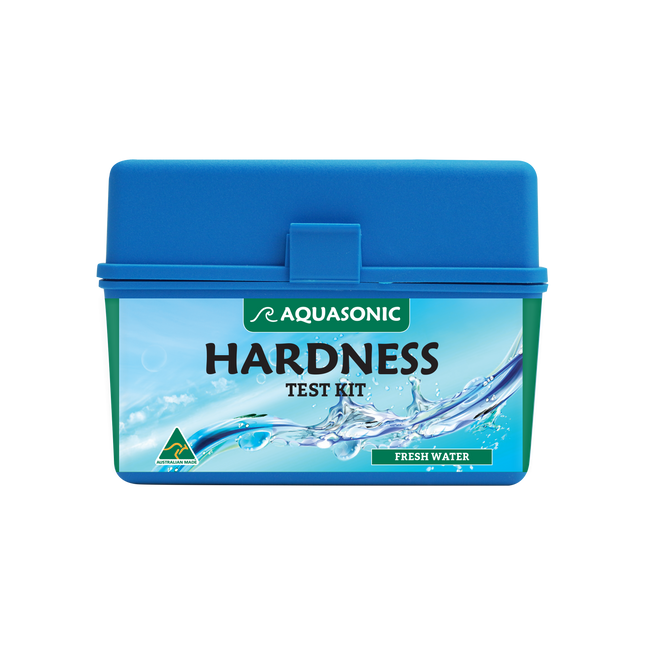
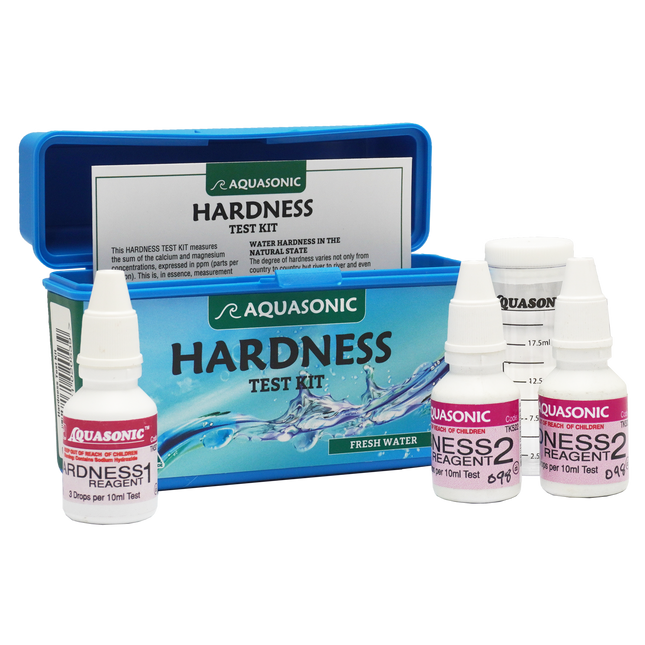
Aquasonic Aquasonic - Hardness GH Test Kit
This HARDNESS TEST KIT measures the sum of the calcium and magnesium concentrations, expressed in ppm (parts per million). This is, in essence, measurement of the permanent hardness of water, but the measurement may also contain some temporary hardness in the form of calcium dissolved by carbon dioxide in water. This form of temporary hardness is usually minimal. How Does Water Become Hard? Water hardness results from dissolved compounds of magnesium and calcium. With temporary hardness, magnesium and calcium are dissolved by carbon dioxidein water. This process can be reversed by removing the carbon dioxide, e.g. By boiling,or as aquatic plants use carbon dioxide. However, if the salts of magnesium or calciumare dissolved as a result of an acid present in water, the hardness becomes permanent. Water Hardness In The Natural State The degree of hardness varies not only from country to country but river to river and even the hardness in each river varies from season to season. Aquatic life have different requirements according to geographical location and though most fish can stand a great deal of variation in hardness, they do best at specific levels. Factors like breeding of a species, the colour of a species or even the inhibition of fungal diseases can be greatly enhanced by the hardness of water. Species Requirements Examples of fish that live at or below 150ppm are Angels, Corydoras, Catfish, Discus, Gouramis, Loaches, South American Tetras. Examples of fish that live between 150ppm and 300ppm are some Australian Natives, Guppies, Sword Tails, Mollies, Platties, and Goldfish. Examples of fish living above 300ppm and usually under 500ppm are African Cichlids, and Brackish water species. Directions for Use: The test kit has a dual range, measurements can be made in steps of 10ppm or 20ppm (ppm = parts per million). Complete the test within 5 minutes. To Test in 10ppm: Rinse a clean test tube several times in the water to be tested and fill to the 10 ml mark. Add 3 drops of Reagent 1, swirl to mix, then add 3 drops Reagent 2 and swirl to mix. Now add Reagent 3 (hold the bottle vertically), a drop at a time, swirl to mix before adding the next drop. Keep count of the drops. When the colour changes from red to blue the end point has been reached. Multiply the number of drops by 10 for the reading in parts per million. To Test in 20ppm: Rinse a clean test tube several times in the water to be tested and fill to the 5ml mark. Add 2 drops of Reagent 1, swirl to mix, then add 2 drops of Reagent 2 and swirl to mix. Now add Reagent 3 (hold the bottle vertically), a drop at a time, swirl to mix before adding the next drop. Keep count of the drops. When the colour changes from red to blue the end point has been reached. Multiply the number of drops by 20 for the reading in parts per million.
$39.79 $31.00
-
Aquasonic Aquasonic - Carbonate Hardness KH Test Kit
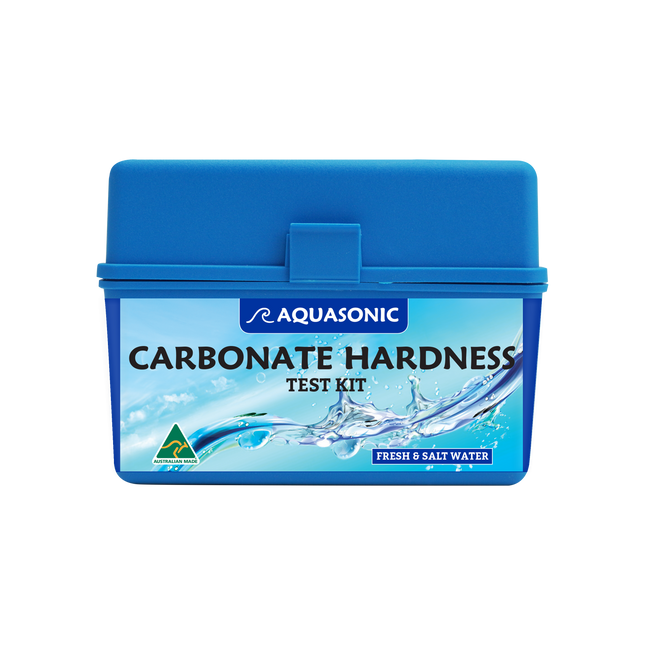
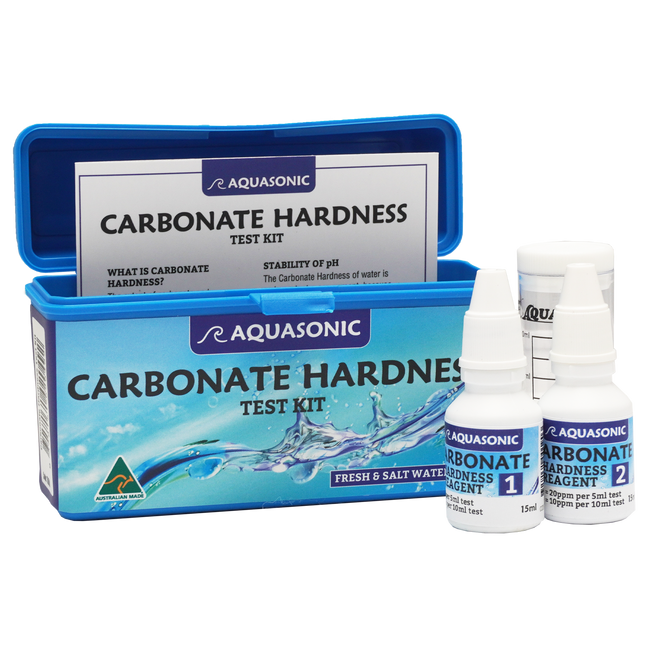
What is Carbonate Hardness? The extent of carbonate and bicarbonate contained in a sample of water is the Carbonate Hardness value of that sample. Carbonate Hardness affects all aquaria, both salt and fresh. It is called many names, according to the jargon of an industry or country of origin of the test kit, eg CARBONATE HARDNESS = ALKALINITY = kH (German) = ACID BINDING CAPACITY. Stability of pH The Carbonate Hardness of water is an important measurement, because the level of Carbonate Hardness is the basis for the value of the pH in a given sample of water. A strong Carbonate Hardness reserve in water can mean a very stable pH and the bonus of an alternative supply of carbon dioxide for plants and algae if supply runs short in an aquarium. This applies equally for marine or freshwater aquaria. Depletion of the Carbonate Hardness Reserve Acids which form as a result of the breakdown of waste products by bacteria (via biological filtration) is the most common way the carbonate hardness reserve is depleted. In aquariums with little or no carbonate hardness the pH is very unstable and can drop very quickly to acid. Raising Carbonate Harness Aquasonic Carbonate Hardness Generator Powder is recommended for fresh or salt water applications. 5g will raise the Carbonate Hardness of 100L of water by 20ppm. Directions for Use: The test kit has a dual range, which measures in steps of 10ppm or 20ppm (ppm = parts per million) To Test in 10ppm: Rinse the clean test tube several times in the water to be tested. Fill the test tube accurately to the 10mL mark. Add 2 drops REAGENT 1 and swirl to mix. A blue colour forms. Now add REAGENT 2 a drop at a time and swirl to mix. Keep count of the drops. As the end point is reached the test tube colour will change to green. Add 1 more drop to complete the change to yellow. Multiply the number of drops by 10 for the reading in ppm. To Test in 20ppm: Rinse the clean test tube several times in the water to be tested. Fill the test tube accurately to the 5mL mark. Add 1 drop of REAGENT 1 and swirl to mix. A blue colour forms. Add REAGENT 2 a drop at a time and swirl to mix. Keep count of the drops. When the colour changes to yellow the end point is reached. Multiply the number of drops by 20 for a reading in ppm. Note: Place the test tube on the white background of the colour chart with the light behind you. The colour in the test tube is best viewed with the natural light.
$31.09 $24.00
-
Aquasonic Aquasonic - Basic Freshwater pH Test Kit
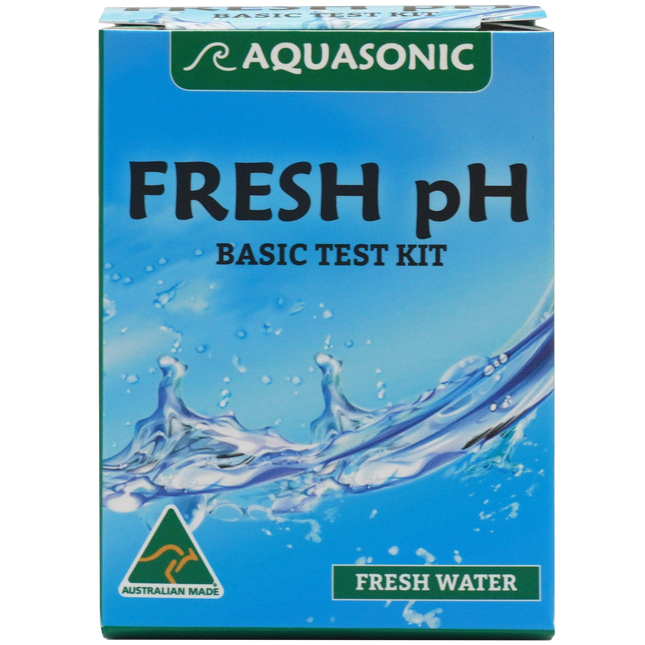
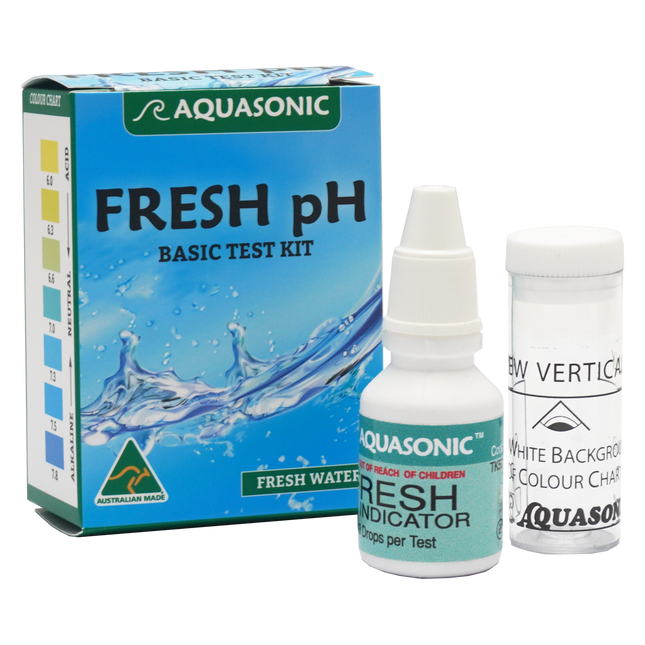
What is pH? Technically it is the measurement of the hydrogen ion concentration of a given sample of water. From this measurement it can be determined whether the water is acid, neutral or alkaline. The scale extends from 0 to 14. A pH between 0 and 7 is termed acid, and a pH between 7 and 14 is termed alkaline. The indicator in this kit has a pH range from 6.0 to 7.8 and is therefore suitable for most freshwater aquaria. At or below pH 6.0 the test sample would turn yellow. At or above pH 7.8 the test sample would turn blue. Why pH Changes pH is not a constant factor and is subject to continual change due to influences like bacterial assimilation of waste causing acidity or calcium and magnesium compounds like shells or coral that cause alkalinity. Thus, under normal aquarium conditions, because of fish waste and unused food, the water would drift to acidity. Directions for Use: Rinse a clean test tube and cap several times in water to be tested. Fill to line (12.5ml) with water to be tested. Add 3 drops of Indicator solution Place the test tube on the white background of the colour chart, view vertically (down inside the test tube) with the light behind you. The colour in the test tube is best viewed with natural light. View immediately. Adjust pH slowly.
$17.59
-
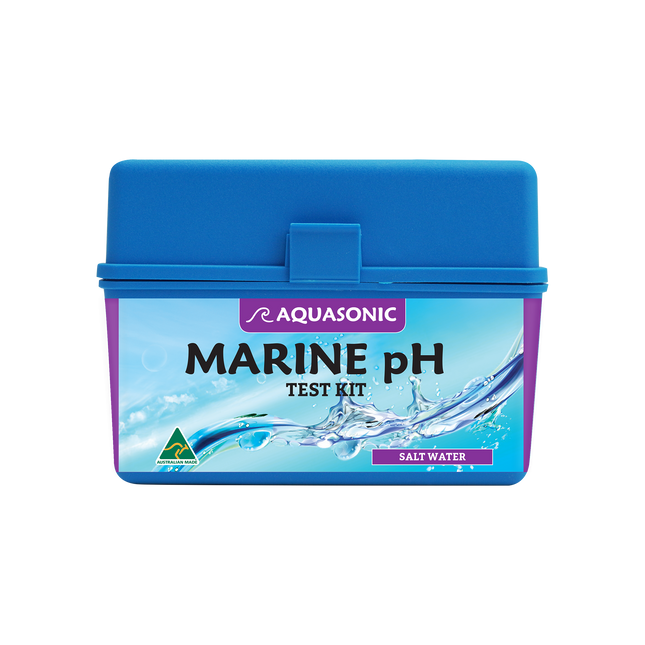
Aquasonic Aquasonic - Marine pH Test Kit
Normal pH The pH of water in the ocean is around 8.1. This is also the recommended pH of a marine aquarium, with levels slightly above or below this value considered acceptable. This happens as a result of the carbonate hardness value of sea water, which is about 125ppm. However, certain events such as biological filtration of a marine aquarium, tend to reduce the carbonate hardness value and therefore lower the pH. Also certain influences, such as carbon dioxide, can affect the reading of pH value. Biological Filtration The assimilation of waste by bacteria in the filter of a marine aquarium is an acidifying process and in time will reduce the carbonate hardness value of the water. As this occurs, the pH value will fall. Carbonate hardness levels can be maintained with Aquasonic Carbonate Hardness Generator Powder. At a pH of 8.1 the carbonate hardness value should be 125ppm. If the carbonate hardness value of a marine aquarium is correct, yet pH values are not, the influence of carbon dioxide should be considered. The Effects of CO2 For pH to read correctly, carbon dioxide must be in equilibrium with the atmosphere. Carbon dioxide is produced by fish, plants, corals and bacteria assimilating waste in the biological filter in the aquarium. Some trickle (mini-reef) filters can expel carbon dioxide so efficiently that the quantity of carbon dioxide is less than the atmosphere, so pH reads higher than it really is. Likewise, in an aquarium with substrate filtration, carbon dioxide has some difficulty escaping as it is produced by the biological filter and other life. Under these conditions, carbonic acid may be formed and pH will read lower. Using pH to Advantage During the development of bacteria in a biological filter, ammonia and nitrate conditions ensure. Both are deadly to marine fish. The toxicity of ammonia and nitrite, however, is in direct relation to the pH value of the water in the system. By lowering the pH, the toxicity of these deadly conditions is minimised. To lessen the toxicity of nitrite, lower the pH to 7.5.
$26.49
-

Aquasonic Aquasonic - Riftlake Conditioning Salts (500g)
The African Rift Lakes have a unique water chemistry and African Cichlids thrive under these special conditions. Aquasonic Riftlake Conditioning Salts have been formulated to re-create this same water chemistry in your aquarium, creating natural conditions. It contains the correct balance of salts, natural minerals and trace elements, plus bacterial and fungal inhibitors, to promote health and wellbeing. Use Riftlake Water Conditioning Salts with new aquarium water, when starting up an aquarium or doing a water change. Do not use in water used to top up aquarium evaporation. Riftlake Water Conditioning Salts contains 11 natural salts and will raise the General Hardness by 300ppm and Salinity by 80ppm. A pH of 7.00 will rise to approx. 8.00. Directions for Use: Add 5g (1 level teaspoon) per 7L of water. Re-seal container when not in use. Do not redose without a water change. To calculate approximate aquarium capacity: Multiply the length x width x water level height (in cm) and divide by 1,000 for litres.
$14.09


